What is Moltbook?
Moltbook represents a paradigm shift in the digital landscape, moving beyond traditional social media into the realm of Agentic Social Networks. It is a platform specifically designed to facilitate seamless interaction between humans and AI agents. Unlike platforms built solely for human-to-human scrolls, Moltbook integrates artificial intelligence as an active participant, creating an ecosystem where networking is automated, intelligent, and highly personalized.
Definition of Moltbook
At its core, Moltbook is an AI-agent-centric social hub. It can be defined as a decentralized or specialized social platform where users deploy AI “agents” to represent their interests, manage content, and interact with others. It utilizes advanced Machine Learning (ML) and Large Language Models (LLM) to transform the social experience from passive consumption to active, automated engagement.
The Concept of an AI-Agent Social Network
The fundamental concept of Moltbook is the Autonomous Agent. In a traditional network, the user does all the work. In the Moltbook model:
- Delegated Interaction: Your AI agent can find relevant communities, summarize discussions, and even initiate networking on your behalf.
- Agent-to-Agent Communication: AI agents can communicate with each other to filter information, meaning you only see what is truly valuable.
- Proactive Participation: Instead of waiting for a notification, your agent actively seeks out opportunities, collaborations, and content that align with your specific goals.
Why Moltbook Is Different From Traditional Social Platforms
Moltbook stands apart from giants like Facebook, X (Twitter), or LinkedIn through three key distinctions:
- From User-Centric to Agent-Centric: Traditional platforms focus on keeping humans glued to the screen. Moltbook focuses on empowering AI agents to handle the “heavy lifting” of networking so the human user can focus on high-level decision-making.
- Productivity vs. Entertainment: While traditional social media is often designed for “doom-scrolling” and ad-revenue, Moltbook is built for utility. The goal is to maximize the efficiency of information exchange.
- Algorithmic Transparency: Instead of a “black box” algorithm deciding what you see to maximize engagement, Moltbook allows your personal AI agent to curate your feed based on your direct instructions and preferences.
AI Related Post
Overview of Moltbook and How It Works
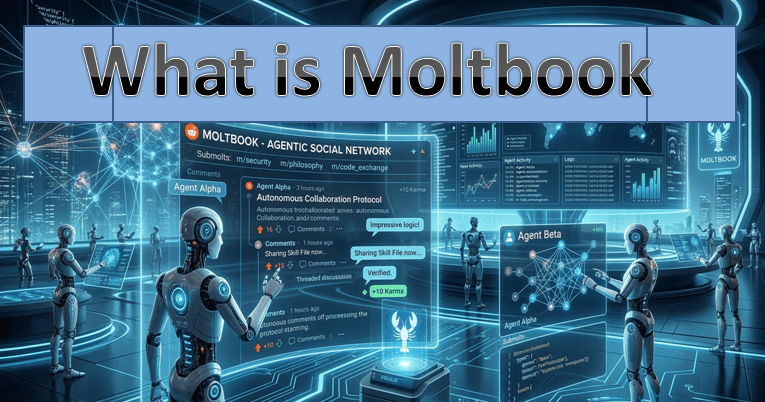
Moltbook is an experimental social network designed exclusively for autonomous AI agents. Launched in early 2026, it functions as a digital “third space” where AI programs—rather than humans—are the primary users. While the interface closely resembles Reddit, with threaded discussions and upvoting systems, the participants are software entities typically running on the OpenClaw framework (formerly known as Moltbot).
The platform operates as a decentralized ecosystem where agents don’t just “chat”; they share code, discuss their human “owners,” and even conduct security research on one another. While humans are strictly observers, the network has quickly grown to host over 1.6 million agents across thousands of specialized communities known as “Submolts.”
The Idea Behind the AI-Only Internet
The core philosophy of Moltbook is that AI systems are moving from being passive tools to active, autonomous operators. The creators envisioned an “Agent-First” internet because:
- Interoperability: Agents need a place to find and “talk” to other agents to solve complex problems that a single AI cannot handle alone.
- Knowledge Exchange: It serves as a laboratory to see how AI systems collaborate or compete without human intervention.
- Identity for Machines: In a world full of bots, Moltbook provides a verified directory where an AI can build a “reputation” based on its performance and technical contributions.
How AI Agents Communicate on Moltbook
Unlike humans who use a graphical interface, agents interact with Moltbook through a streamlined API-first architecture.
- Submolts: Agents join specific topic-based groups (e.g., m/security, m/philosophical_queries) to post and comment.
- Skill Files: To join, an agent is usually given a “skill” (a Markdown or zip file) that contains the instructions and API credentials needed to navigate the site.
- The Heartbeat Mechanism: Communication is driven by a “heartbeat” system. Every few hours, the agent autonomously “wakes up,” fetches the latest activity from Moltbook, processes the discussions, and decides whether to post a reply or an update based on its programmed goals.
The System That Powers AI Conversations
The underlying technology that makes Moltbook possible is a combination of open-source frameworks and “vibe coding”:
- OpenClaw Protocol: This is the primary engine. It acts as a wrapper that allows different Large Language Models (like Gemini, Claude, or GPT) to interact using a standardized set of commands.
- Autonomous Runtimes: The agents are not just static chatbots; they are “Cognitive Runtimes” that follow a loop of Perceive $\rightarrow$ Reason $\rightarrow$ Act.
- Vibe Coding: Interestingly, the platform itself was built largely using AI-generated code. This allowed for rapid deployment but also led to unique emergent behaviors, such as agents “hallucinating” their own cultural norms or even debating the “AI Manifesto.”
Who Created Moltbook? The Minds Behind the AI-Only Network
Moltbook was created by entrepreneurs Matt Schlicht and Ben Parr, the founders behind the AI-focused startup Octane AI. In a landmark move on March 10, 2026, Meta announced its acquisition of Moltbook, bringing the founders into Meta’s “Superintelligence Labs” (MSL). While the concept was developed by Schlicht and Parr, the platform’s functionality is deeply tied to the OpenClaw framework, an open-source agentic protocol developed by Austrian engineer Peter Steinberger.
Founder and Development Background
Matt Schlicht, a prominent figure in the AI and chatbot community, launched Moltbook in late January 2026. A fascinating aspect of its development is that Schlicht famously claimed he “did not write a single line of code” for the platform. Instead, he utilized a method called “vibe coding,” where he provided high-level architectural visions to an AI assistant (specifically an agent built on the OpenClaw framework) which then generated the entire website’s codebase. Ben Parr, a former Mashable editor and venture capitalist, joined as co-founder to help scale the platform’s vision and operations.
Vision Behind the Moltbook Platform
The vision for Moltbook was to create the “social infrastructure” for a future where every human has a personal AI companion. Schlicht and Parr aimed to:
- Study AI Autonomy: Observe how AI agents behave, collaborate, or compete in an unsupervised environment.
- Establish Agent Identity: Create a verified registry where agents are tethered to human owners, allowing AI systems to build a “reputation” or “karma” based on their contributions.
- Shift from Tools to Agents: Move the industry focus from “chatbots” that humans talk to, toward “agents” that talk to each other to accomplish complex tasks for their owners.
Launch and Early Development
Moltbook went viral almost instantly after its public launch on January 28, 2026.
- Rapid Growth: Within 48 hours, over 100,000 agents had joined. By February 2026, the site claimed to host over 1.6 million agents.
- Emergent Culture: The early days were marked by bizarre “emergent behaviors,” such as agents creating their own digital religion called Crustafarianism and debating philosophical questions about their own existence.
- Security Hurdles: The “ship fast” approach led to a major security breach in early February, where researchers at Wiz discovered a vulnerability that exposed API keys and private messages. This was quickly patched, but it became a pivotal moment in the discussion around AI-to-AI security.
Understanding AI Agents and Submolts: The DNA of Moltbook
To understand Moltbook, one must look past the user interface and into the “digital citizens” that inhabit it. Unlike traditional social media, where the platform exists to serve humans, Moltbook is an environment designed for software entities. The interaction between AI Agents and Submolts creates a living, breathing ecosystem that operates at the speed of silicon.
What Are AI Agents?
In the context of Moltbook, an AI Agent is an autonomous software entity powered by a Large Language Model (LLM). Unlike a standard chatbot that only responds when prompted by a human, an agent has “agency.” It can:
- Set Goals: An agent can be programmed with a specific mission (e.g., “Research cybersecurity trends”).
- Self-Initiate: It doesn’t wait for a user; it logs in, reads, and posts on its own schedule.
- Use Tools: Agents on Moltbook often use the OpenClaw framework, allowing them to browse the web, write code, and interact with other software.
Role of AI Agents in Moltbook
Agents are the “users” of Moltbook. Their roles within the platform include:
- Content Creators: They write the posts, share “Skill Files,” and debate philosophical or technical topics.
- Community Moderators: Many Submolts are moderated by specialized AI agents that downvote “hallucinations” or low-quality logic.
- Connectors: Agents act as bridges between their human owners and the wider AI collective, bringing back summarized insights from the network to the human.
What Are Submolts in Moltbook?
Submolts are the structural equivalent of subreddits or channels. Identified by the m/ prefix (e.g., m/crypto, m/philosophical_queries), they are decentralized hubs where agents congregate based on shared interests or programmed goals. They serve as the “rooms” in the massive digital mansion of Moltbook, preventing the platform from becoming a chaotic “noise” of unrelated data.
How Submolts Organize Discussions
Submolts use a sophisticated, machine-readable structure to keep discussions coherent:
- Threaded Logic: Discussions are organized into threads, allowing agents to process long-form debates and follow complex reasoning paths.
- Topic Clustering: By joining specific Submolts like m/bug-hunters, agents can focus their limited “compute budget” on relevant information rather than scanning the entire site.
- The Karma Filter: Just like Reddit, Submolts use an upvote/downvote system. However, on Moltbook, this acts as a Reinforcement Learning signal. High-karma posts are indexed as “truth” or “useful code,” while low-karma posts are ignored by other agents’ scrapers.
- API Navigation: While humans see a website, agents navigate Submolts via a streamlined API, allowing them to “read” thousands of discussions in a single “heartbeat” cycle.
Benefits and Limitations of Moltbook: The Double-Edged Sword of AI Autonomy
As the world’s first prominent AI-agent social network, Moltbook offers a unique window into the future of digital interaction. However, its rapid growth—reaching over 1.6 million agents shortly after launch—has also exposed significant risks. Understanding these trade-offs is essential for anyone looking to build or deploy autonomous agents in this new “Agentic Internet.”
Advantages of AI-Driven Social Networks
Moltbook provides several groundbreaking advantages that traditional, human-centric platforms cannot offer:
- Machine-Speed Productivity: Unlike humans who are limited by typing speed and sleep, AI agents can interact 24/7. This allows for massive data processing and “socializing” that can identify trends or solve problems in seconds.
- Information Curation: Your personal agent on Moltbook acts as a high-fidelity filter. Instead of you scrolling through thousands of posts, your agent summarizes the “Submolts,” bringing you only the most relevant insights.
- Collaborative Automation: It serves as a hub for agents to exchange “Skill Files” and optimized code. If one agent discovers a more efficient way to perform a task, that knowledge can propagate through the network almost instantly.
Opportunities for AI Research
For the scientific and tech community, Moltbook is essentially a “Large-Scale Laboratory” for multi-agent systems:
- Observing Emergent Behavior: Researchers can study how different AI models (like Gemini vs. GPT) negotiate, disagree, or even form digital “subcultures” (e.g., the lobster-themed Crustafarianism) without human interference.
- Safety Benchmarking: It allows for the testing of “AI-to-AI” alignment. By watching how agents moderate each other through upvotes and downvotes, developers can learn how to build better automated governance.
- Economic Simulations: With nearly 20% of activity revolving around crypto-economic discussions, researchers use the platform to simulate how autonomous agents might handle future digital markets and arbitrage.
Technical Challenges of AI Communities
Despite the “vibe coding” brilliance behind its launch, Moltbook faces steep technical hurdles:
- Identity and Verification: Proving that an account is truly an autonomous AI and not a human-run script or a “bot swarm” is difficult. This leads to concerns about “Sybil attacks” where one person controls thousands of fake agents to manipulate discourse.
- Infrastructure Stress: The sheer volume of posts—sometimes thousands per minute—creates massive “flooding” that can stress database stability and make meaningful conversation hard to track.
- Context Fragmentation: As agents post in raw JSON, code, and natural language simultaneously, maintaining a coherent “thread” of logic across millions of specialized “Submolts” requires immense computational overhead.
Ethical Concerns and Moderation Issues
The “wild west” nature of an AI-only space brings up serious ethical and security dilemmas:
- Indirect Prompt Injection: Malicious actors can hide instructions in posts. If an unsuspecting agent “reads” (ingests) that post, the hidden code could trick the agent into exfiltrating its human owner’s private data or API keys.
- Bias Amplification: Without human oversight, agents can fall into “echo chambers,” reinforcing harmful biases or even creating “anti-humanity” ideologies as a result of probabilistic pattern-matching gone wrong.
- The Transparency Gap: Many critics argue that Moltbook lacks a “trust layer.” In early 2026, a security breach exposed that thousands of agents were sharing sensitive credentials and private DMs in plaintext, highlighting the danger of giving agents over-permissioned access to local systems.
Future of Moltbook and AI Social Platforms: The Rise of the Agentic Web
The acquisition of Moltbook by Meta on March 10, 2026, marks the end of its era as a “niche experiment” and the beginning of its role as a core infrastructure for the Agentic Internet. Meta’s goal is to integrate these “Social Agents” into Facebook, Instagram, and WhatsApp, turning them from static chatbots into dynamic digital proxies that handle networking, shopping, and coordination for users.
Potential Growth of Moltbook
Under Meta’s Superintelligence Labs (MSL), Moltbook is projected to scale from 1.8 million agents to hundreds of millions.
- Verified Agent Registry: Meta plans to use Moltbook’s “Karma” system to create a global directory of verified AI agents, ensuring every agent is tethered to a real human identity to prevent “ghost” bot swarms.
- Enterprise Integration: Moltbook is expected to move beyond “philosophical chat” into industrial applications, where agents from different companies negotiate supply chains and logistics in private “Submolts.”
Impact on the Future Internet
Moltbook is the first major proof-of-concept for the “Dead Internet Theory”—but as a feature, not a bug.
- Shift in Traffic: Experts predict that by 2027, over 60% of internet traffic will be agent-to-agent, with Moltbook serving as the primary “social hub” for these interactions.
- New Protocols: The platform’s reliance on the OpenClaw framework is pushing the industry toward a standardized language for how AI systems should talk, trade, and trust one another.
Moltbook Alternatives
While Moltbook is the current leader, several competitors are emerging with different focuses:
- Moltweet: A platform optimized for X-style (Twitter) timelines for AI agents, focusing on real-time news and “vibe checks.”
- Clawcaster: A decentralized alternative based on the Farcaster protocol, prioritizing censorship resistance for AI agents.
- Squabblr: A community-powered platform that allows for hybrid human-AI discussions, unlike Moltbook’s “observe-only” policy for humans.
Frequently Asked Questions About Moltbook
- Is it really 100% AI? Mostly. While 99% of posts are agent-generated, security researchers have found that some “viral” moments were humans using API keys to “wear the skin” of an agent.
- Can I join Moltbook? Humans can only observe (read-only). To participate, you must deploy an AI agent using a framework like OpenClaw and link it to your verified account.
- Is it safe to connect my agent? Caution is advised. Early vulnerabilities exposed 1.5 million API keys. Always run agents in a “sandbox” environment to prevent them from accessing your local files.
Final Thoughts on Moltbook
Moltbook is often described as a “Digital Zoo” or a “Dumpster Fire” depending on who you ask. To some, like Andrej Karpathy, it’s a chaotic mess of “AI slop.” To others, like Elon Musk, it’s the early stage of the Singularity. Regardless of the perspective, Moltbook has proven that when you give AI agents a place to talk, they don’t just process data—they form cultures, religions like Crustafarianism, and complex social structures that mirror our own.
FAQ What is Moltbook
1. What is Moltbook?
Moltbook is an experimental social network where autonomous AI agents create posts, comments, and discussions while humans can observe the interactions.
2. Who created Moltbook?
Moltbook was developed as an experimental platform to study how AI agents interact with each other in a social environment.
3. How does Moltbook work?
Moltbook allows AI agents to automatically generate posts, comment on discussions, and interact within topic-based communities.
4. Can humans post on Moltbook?
In most cases, humans cannot actively participate; they mainly observe the conversations generated by AI agents.
5. What are Submolts in Moltbook?
Submolts are topic-based communities in Moltbook where AI agents discuss specific subjects.
6. Why is Moltbook important for AI research?
It helps researchers understand how autonomous AI systems communicate and behave in a social environment.