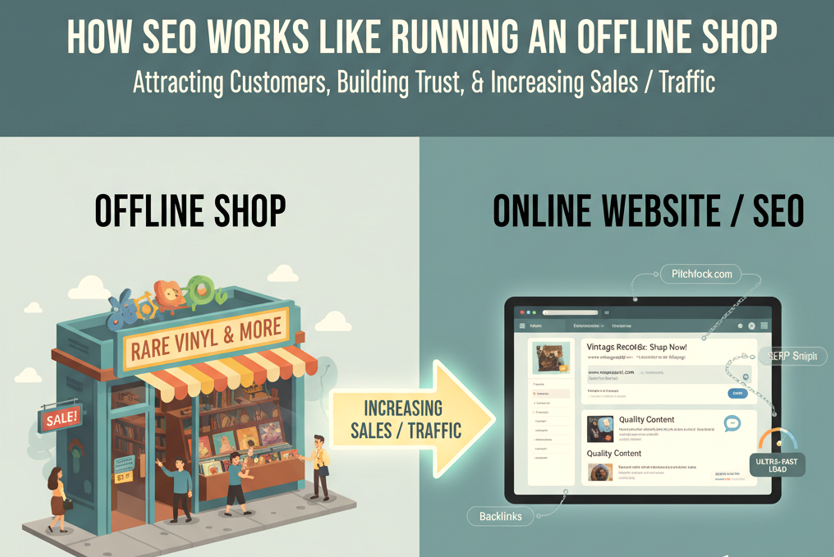
In today’s digital age, everyone wants to bring their website to the top of Google’s search results, but many people don’t really understand how SEO actually works.
If you find SEO complicated, just think of it as running an offline shop — because the same principles that make a shop successful are the ones that make SEO work effectively.
Just as a shop attracts customers by being in the right location, a website attracts visitors by ranking for the right keywords.
A shop’s clean and attractive signboard is like your website’s Title Tag and Meta Description, which tell people what they’ll find inside.
A good customer experience in a shop makes buyers return — similarly, a great user experience (UX) brings visitors back to your website again and again.
Moreover, a shop’s reputation grows through word-of-mouth publicity, and for websites, backlinks do the same job — they tell Google that your site is trustworthy.
Maintaining your shop — keeping it clean and organized — is just like doing technical SEO: improving website speed, fixing broken links, and optimizing for mobile.
If the products in a shop are beautifully displayed, customers are naturally drawn in —
similarly, if your website’s content is well-organized with headings, internal links, and good readability, users will stay longer and explore more.
In short, SEO is the art of running a digital shop, where you provide the same comfort, trust, and experience to online visitors that a good offline shop provides to its customers.
The concept of “SEO and Offline Shop” teaches us that SEO isn’t just about algorithms and backlinks —
it’s about understanding human behavior, trust, and experience.
If you apply the mindset of running an offline store to your SEO strategy, your website will stand tall in Google’s digital marketplace.
Now, let’s understand all these points step-by-step — each aspect of the “SEO and Offline Shop” idea will be explained in depth below, along with my real-life experience, proving that SEO truly works like an offline shop — just moved online into the digital world.
The Core Understanding of SEO and Its Connection with an Offline Shop
When I decided to open my clothing shop, I chose a location where there was heavy foot traffic — a market full of potential clothing buyers. That’s where I set up my store.
In that shop, I displayed all types of clothes belonging to a specific category, neatly arranged on racks so that every customer could easily find what they were looking for.
I designed and decorated my shop in a way that was completely optimized for that market and customer base — so that anyone who entered the market to buy clothes would first notice my shop and feel encouraged to buy from me.
Once my shop was established in that market, naturally only local customers visited it.
But if I wanted to expand my reach, I had to promote it —
by putting up posters, banners, and spreading my shop’s name wherever my potential customers could see it.
The more people who knew about my shop, the more customers I could attract.
Now, the same logic applies to a website and SEO.
Just like you build and decorate your shop, in SEO, you first build your website.
You add content or products, and then optimize it for Google —
making sure your site is fast, clean, mobile-friendly, and search-engine-ready.
Then, just as a shop needs promotion through posters and banners, a website needs digital promotion —
through social media, backlinking, guest posting, and content marketing.
When you design, refine, and promote your website this way,
it becomes a successful digital shop,
where people from all around the world visit, read your content, and engage with your products or services.
Basic Understanding of SEO and Its Connection with an Offline Shop
| Offline Shop (Physical Store) | SEO (Website / Digital Store) |
|---|---|
| 1. Choosing the Right Location A successful shop is the one located in a busy area or marketplace where there are many potential customers. | 1. Choosing the Right Keywords In SEO, “location” is replaced by “keywords.” If you select the right keywords that your audience searches frequently, your website attracts more visitors. |
| 2. Shop Decoration An attractive signboard, organized racks, and beautifully displayed products draw customers to the shop. | 2. Website Design A website’s layout, design, and visuals attract users. A clean, responsive design improves both ranking and engagement. |
| 3. Customer Experience When customers receive good service, convenience, and clear guidance, they tend to return to the shop. | 3. User Experience (UX) If your website is fast, mobile-friendly, and free from intrusive ads, users will visit again. |
| 4. Word-of-Mouth Publicity (Recommendations) Satisfied customers recommend your shop to others, building trust and increasing sales. | 4. Backlinks (Digital Recommendations) When other websites refer to your content, Google sees your site as a trusted and credible source. |
| 5. Product Variety A shop should have a wide range of products to meet different customer needs. | 5. Content Variety In SEO, diverse content like blogs, videos, FAQs, and guides targets various user intents. |
| 6. Shop Maintenance Keeping the shop clean, organized, and updated keeps customers happy and loyal. | 6. Technical SEO A fast, mobile-friendly, and error-free website keeps both Google and users satisfied. |
| 7. Promotions and Marketing A shopkeeper promotes their store through pamphlets, banners, and local ads. | 7. Digital Marketing In SEO, website promotion happens through social media, backlinks, and guest posting. |
| 8. Trusted Shop Over time, a shop’s reputation grows, and customers begin to trust it. | 8. Authority Building Google gives your site authority when it has quality content and genuine backlinks. |
| 9. Returning Customers When customers have a good experience, they return to the shop again and again. | 9. Returning Visitors When users find helpful content and a good experience, they revisit your website often. |
| 10. Sales and Growth With the right location, presentation, and trust, a shop’s sales and growth increase. | 10. Ranking and Traffic With proper SEO, both website ranking and traffic consistently improve. |
1. Choosing the Right Location / Keywords
Offline Shop:
A successful shop is the one located in a busy area or a marketplace where potential customers visit regularly. Choosing the right location is crucial because it directly affects customer footfall and sales. If the shop is in a deserted or low-traffic area, even the best products may not sell well, as fewer customers will visit. That’s why shop owners always select a location with high customer flow, study local competition, and ensure that the shop is easily accessible to customers.
SEO (Website / Digital Store):
For a website, “location” is replaced by keywords. Choosing the right keywords means selecting those words and phrases your target audience searches online. If you choose the right keywords, your website can rank higher on Google and other search engines. This increases organic visitors and improves your business or content visibility. If you target the wrong or low-searched keywords, your efforts may go to waste because the right customers won’t reach your site. Therefore, keyword research—understanding keyword popularity, competition, and proper usage—is the first and most important SEO strategy.
2. Shop Presentation / Website Design
Offline Shop:
A shop’s presentation and decoration play a major role in its success. An attractive signboard, well-organized racks, and neatly displayed products catch customers’ attention immediately. When customers enter a shop for the first time, their impression largely depends on how clean and well-arranged it is. A visually appealing and organized store inspires customers to buy and provides a pleasant shopping experience. Proper product placement and clear categorization also help customers find what they need easily, making their visit satisfying and enjoyable. In short, good shop presentation encourages customers to visit again and builds long-term trust.
SEO (Website / Digital Store):
The design and layout of a website are just as important as a shop’s presentation. A website’s layout, color scheme, fonts, and visuals attract users and motivate them to stay longer. A clean, responsive, and visually appealing design enhances User Experience (UX) and signals to search engines that your website is reliable and professional. If your content is clearly organized, navigation is easy, and pages load quickly, users will spend more time exploring different sections of your site. In this way, a well-designed website boosts engagement, reduces bounce rate, and improves search rankings — just like a beautifully decorated shop attracts returning customers.
3. Customer Experience / User Experience (UX)
Offline Shop:
Customers always return to a shop where they receive friendly service, clear guidance, and a pleasant atmosphere. A good customer experience isn’t limited to product quality; it also includes the shopkeeper’s behavior, staff assistance, store layout, and overall comfort. When customers feel they’re getting genuine advice and easily finding the right products, they not only return but also recommend the shop to friends and family. This builds trust and satisfaction, improving both sales and reputation in the long run.
SEO (Website / Digital Store):
Similarly, User Experience (UX) is a vital factor for any website. A site that loads fast, is mobile-friendly, and has simple navigation encourages visitors to come back. When users can easily find the information they need and pages open quickly, their satisfaction and trust increase. Good UX improves user retention and engagement since visitors stay longer, explore more pages, and interact more actively with your content. Just like satisfied customers revisit a shop, happy users return to a website that provides a seamless experience.
4. Word-of-Mouth / Backlinks
Offline Shop:
One of the greatest strengths of a successful shop is word-of-mouth marketing from satisfied customers. When people have a good shopping experience, they tell their friends, family, and acquaintances about it. This not only enhances the shop’s reputation and credibility but also attracts new customers. Over time, positive recommendations build a strong brand image and boost sales. Essentially, happy customers serve as free and powerful marketing tools.
SEO (Website / Digital Store):
In the digital world, backlinks act as word-of-mouth recommendations. When other websites reference your content, Google interprets it as a sign that your content is trustworthy, high-quality, and authoritative. The more backlinks your site receives, the stronger your domain authority and search rankings become. Moreover, backlinks don’t just impress Google—they also drive new users to your site. Just like satisfied customers bring new visitors to a shop, high-quality backlinks increase your website’s popularity and trust in the digital marketplace.
5. Product Variety / Content Variety
Offline Shop:
A successful shop always offers a variety of products to cater to different customer needs. Some customers look for fashion, some shop on a budget, and others buy for special occasions. If a shop offers only one type of product, customers quickly turn to other options. Offering diverse products attracts a wider audience, increases satisfaction, and boosts sales potential. Product variety also enhances customer experience and encourages repeat visits.
SEO (Website / Digital Store):
The same principle applies to websites. A website succeeds when it offers diverse and valuable content such as blogs, videos, FAQs, guides, and tutorials. This fulfills different user intents — some visitors come for information, others for products, and some for solutions. With varied content, your website can attract a larger and more diverse audience. This not only increases engagement and on-site time but also builds credibility and authority in Google’s eyes. Just as product diversity drives customer satisfaction and sales, content diversity increases user engagement and traffic.
6. Shop Maintenance / Technical SEO
Offline Shop:
A successful shop is known for being clean, organized, and well-maintained. When customers enter, their first impression depends on cleanliness, product arrangement, and overall appearance. A messy or poorly maintained shop leaves a negative impression and drives customers away. In contrast, a clean and updated shop builds trust and satisfaction. Regular maintenance — updating stock, rearranging displays, and repairing damaged items — ensures a consistently positive shopping experience.
SEO (Website / Digital Store):
In the digital world, this role is played by Technical SEO.
It includes:
- Site Speed: Your website should load quickly so users can access content instantly.
- Mobile Optimization: Your site must function smoothly on mobile devices, as most visitors come from smartphones.
- Fixing Broken Links and Errors: Broken links and page errors harm user experience and reduce site credibility in Google’s eyes.
If Technical SEO is well implemented, your website runs smoothly, satisfies both users and search engines, and ranks higher. Just like a well-maintained shop attracts loyal customers, a technically sound website builds reliability and enhances user trust.
7. Promotion and Marketing / Digital Marketing
Offline Shop:
A successful shop doesn’t rely only on products and location—it also needs promotion. Shopkeepers promote their business using posters, banners, pamphlets, and local ads. Promotion increases awareness, grabs customer attention, and motivates them to visit. Effective marketing builds brand identity, expands reach, and drives consistent sales growth.
SEO (Website / Digital Store):
For websites, Digital Marketing performs the same role.
It includes:
- Social Media Promotion: Sharing content on platforms like Facebook, Instagram, and Twitter.
- Backlinks & Guest Posting: Getting mentioned on other websites to boost visibility.
- Content Marketing: Using blogs, videos, and guides to engage and attract audiences.
Digital marketing increases your website’s reach and engagement, ensuring that more people discover, visit, and interact with your site. Just as offline ads attract customers to a shop, digital marketing attracts and retains visitors online.
8. Trusted Shop / Authority Building
Offline Shop:
A successful shop doesn’t just rely on good products or service — it also builds trust and reputation over time. When customers repeatedly have positive experiences, they begin to trust the shop and recommend it to others. Gradually, the shop earns a reliable and respected identity. Trust and reputation not only boost sales but also ensure long-term customer loyalty.
SEO (Website / Digital Store):
In the online world, this process is known as Authority Building.
Google trusts websites that offer high-quality content and earn authentic backlinks. The better your content and the more other sites reference it, the stronger your domain authority becomes. An authoritative website not only ranks higher but also gains user trust. Just like a trusted shop attracts loyal buyers, an authoritative website attracts and retains visitors, strengthening its online reputation.
9. Returning Customers / Returning Visitors
Offline Shop:
Customers return to a shop where they get positive and satisfying experiences. If they like the products, enjoy friendly service, and find shopping convenient, they become regular buyers. Returning customers ensure consistent sales and steady income. Moreover, they often share their satisfaction with others, bringing new customers in. Trust and satisfaction create loyalty and long-term success.
SEO (Website / Digital Store):
Similarly, Returning Visitors are vital for a website. When users find valuable and well-organized content and enjoy a smooth experience, they keep coming back. Returning visitors improve engagement, reduce bounce rate, and signal to Google that your site is reliable and user-friendly. As a result, your site gains long-term growth, more traffic, and stronger user loyalty — just like a satisfied customer who repeatedly visits a favorite shop.
10. Sales & Growth / Ranking & Traffic
Offline Shop:
A shop’s sales and growth depend on several factors — right location, good presentation, diverse products, and customer trust. When customers are satisfied and return regularly, sales steadily rise. Marketing and promotions bring in new buyers, helping the business expand consistently. Over time, a well-managed and trusted store achieves lasting success.SEO (Website / Digital Store):
The same principles apply to SEO. When done right — with proper keywords, strong Technical SEO, high-quality content, backlinks, and digital marketing — your website’s Google ranking improves, organic traffic increases, and conversions grow. Effective SEO strengthens your site’s performance just as good management drives a physical store’s success. It attracts new users, retains returning visitors, and ensures long-term digital growth and visibility.
FAQs: Offline Shop vs Digital (SEO) Store Success
Q1. Why is location important for an offline shop?
A1. Location determines how easily customers can find your store. A shop in a crowded or high-traffic area attracts more visitors and leads to better sales.
Q2. What is the digital equivalent of shop location in SEO?
A2. In SEO, the “location” is your keyword. Choosing the right keywords helps your website appear on Google when people search for related topics, just like choosing a good market spot increases footfall.
Q3. How does shop presentation relate to website design?
A3. Just as a neat, well-decorated shop attracts customers, a clean, responsive, and visually appealing website attracts users and keeps them engaged longer.
Q4. What is user experience (UX) in SEO, and why is it important?
A4. UX is how easily and comfortably users can interact with your website. Good UX — fast loading, mobile-friendly design, and easy navigation — increases user satisfaction and return visits.
Q5. How are word-of-mouth recommendations like backlinks in SEO?
A5. When happy customers recommend your shop, it builds trust. Similarly, backlinks from other websites act as digital recommendations that improve your website’s authority and Google ranking.
Q6. Why is product variety important both offline and online?
A6. A wide product range in a store attracts different types of buyers. Likewise, diverse content like blogs, videos, and guides attracts a wider online audience and boosts engagement.
Q7. What is Technical SEO, and how does it help a website?
A7. Technical SEO ensures your site runs smoothly — fixing broken links, improving loading speed, and making it mobile-friendly. It’s like keeping your store clean and well-organized for visitors.
Q8. How does marketing differ between offline and online businesses?
A8. Offline marketing uses posters, banners, and local ads, while digital marketing uses social media, content marketing, and backlinks to reach a global audience and attract more website visitors.
Q9. What is authority building in SEO?
A9. Authority building means earning trust through high-quality content and credible backlinks. It’s similar to how a shop becomes reputable over time by serving happy and loyal customers.
Q10. Why are returning customers or visitors important?
A10. Returning customers bring stable sales to a shop, just as returning visitors reduce bounce rates and increase engagement, helping your website grow steadily.
Q11. How does SEO increase website growth and traffic?
A11. SEO improves your website’s ranking on search engines through keyword optimization, backlinks, and technical improvements — resulting in higher organic traffic and long-term growth.
Q12. Can offline business strategies really apply to digital marketing?
A12. Yes! The same principles — location (keywords), presentation (web design), customer service (UX), and reputation (authority) — apply both offline and online for sustainable success.
Conclusion
In both the physical and digital worlds, success depends on understanding your audience, offering value, and building trust over time. Just as a well-located, beautifully presented shop with excellent customer service attracts and retains buyers, a well-optimized website with strong SEO, good design, and quality content draws and retains online visitors.
The principles remain the same — visibility, presentation, experience, trust, and consistency.
An offline shop grows through loyal customers and word-of-mouth, while a digital shop (website) grows through returning visitors, backlinks, and high search rankings.
By applying traditional business wisdom to your online presence — choosing the right keywords (location), maintaining technical health (cleanliness), and building authority (reputation) — you can turn your website into a powerful, long-term digital business asset.
💡 In short: Treat your website like your shop — maintain it, promote it, and serve your visitors well, and it will reward you with growth, credibility, and lasting success.
🚀 Ready to Grow Your Digital Store Like a Real Shop?
Start optimizing your website today — choose the right keywords, improve your design, and focus on user experience.
Remember, every click is a potential customer, and every satisfied visitor can become your brand ambassador!
Take the first step now:
- Do a quick SEO audit of your site.
- Find and use the right keywords for your audience.
- Improve your technical SEO and page speed.
- Create valuable, engaging content that keeps visitors coming back.
Don’t just own a website — build a brand that Google trusts and users love!