
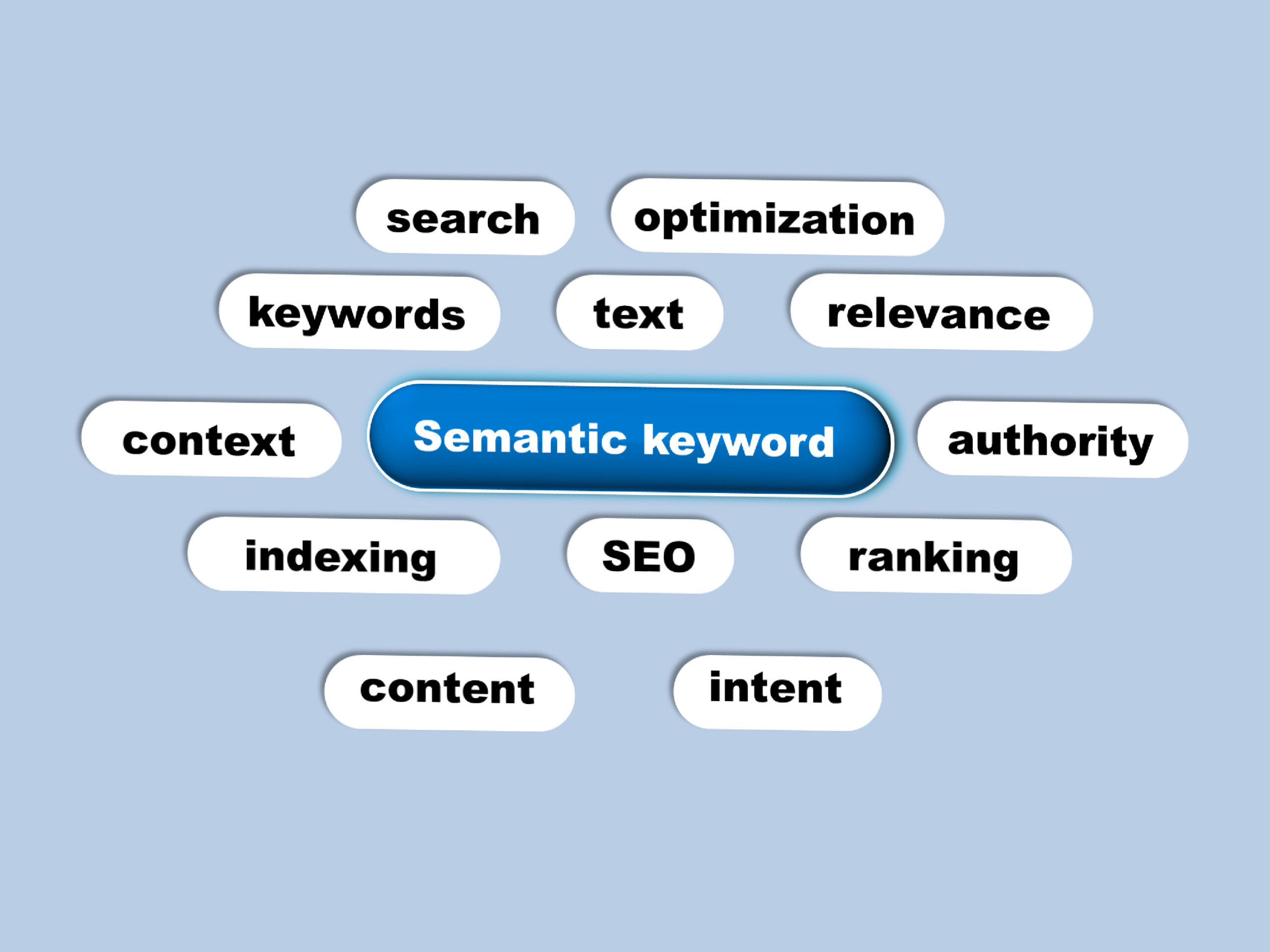
Today’s SEO is no longer limited to just counting keywords. Now Google and other search engines focus on what the user actually wants and how to provide the most accurate and complete answer. That’s why the importance of Semantic Keywords has grown more than ever before.
Semantic Keywords help search engines understand how deeply and comprehensively your content covers a topic.
For example, if someone searches for “Digital Marketing,” then semantic keywords like SEO, Content Marketing, PPC, and Social Media show that your article also contains complete information around the topic.
Google’s RankBrain and BERT Algorithm work on semantic understanding. This means if your content includes the right semantic keywords, Google will consider it more relevant and rank it higher. At the same time, semantic keywords make your content more natural, engaging, and detailed, giving visitors complete answers and reducing your bounce rate.
Semantic Keywords help search engines understand how deeply and comprehensively your content covers a topic. With the help of AI data, you can easily identify related terms and user intent, making your content more effective and search-friendly.
These days, people use voice search and conversational queries much more often. For example, if someone asks – “Best SEO strategy for a new website in 2025” – semantic keywords help the search engine understand the right context and show the user the best result.
With the rise of AI SEO tools, the power of semantic keywords has increased even further. These tools can instantly analyze data and suggest related terms that make your content more relevant and future-ready.
In short, Semantic Keywords are the backbone of modern SEO. They not only help your content rank better in search engines but also assure the user that they are getting the most accurate, correct, and complete answer to their query.
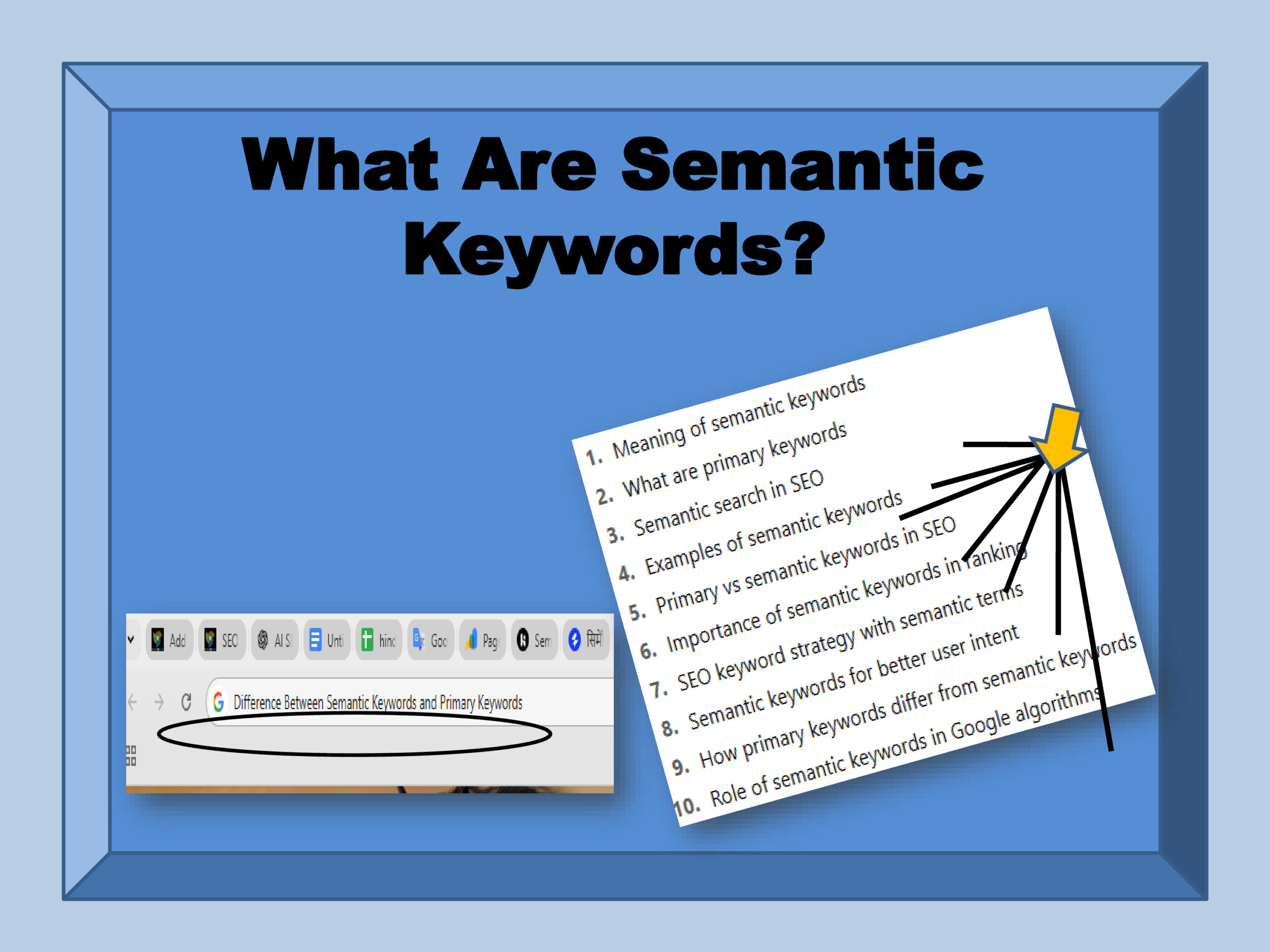
What Are Semantic Keywords?
Imagine you’re talking to a friend, and they ask – “What do you know about Digital Marketing?”
If you just keep repeating “Digital Marketing, Digital Marketing,” they’ll probably find it boring. But if you naturally bring in related words like SEO, Social Media, Content Marketing, PPC Ads, Branding, they’ll feel you truly understand the depth of the topic.
That’s exactly what Semantic Keywords do on the internet.
Semantic Keywords are words or phrases that are connected to the meaning, context, and intent of a primary keyword. They’re not necessarily the exact keyword, but rather the concepts, synonyms, related topics, or user-intent-driven terms around it.
Why Are Semantic Keywords Important?
- They Help Search Engines Understand Context
- Google doesn’t just count keywords anymore. It checks whether your content answers the user’s query in context. Semantic keywords give search engines those signals.
- They Improve User Experience
- When readers see not only the main keyword but also related terms in your article, they feel the content is “complete” and will fully answer their query.
- They Support Voice Search and AI Queries
- These days, people don’t type short keywords—they ask full questions.
Example: “Best SEO strategy for new bloggers in 2025.”
Semantic keywords help Google understand exactly which aspect of SEO the user is looking for.
- These days, people don’t type short keywords—they ask full questions.
- They Make Content Natural and Human-Like
- If you keep stuffing just one keyword, the content feels robotic. Adding semantic keywords makes your writing flow naturally and enjoyable for readers.
A Simple Example
Let’s say your main keyword is: “Healthy Diet.”
- Primary Keyword: Healthy Diet
- Semantic Keywords: Nutrition, Balanced Food, Weight Loss Meal, Protein, Vitamins, Lifestyle Habits
If your blog naturally mixes these terms, Google will understand that you’re covering the topic of Healthy Diet in depth, not just stuffing a single keyword.
The Essence
If SEO is like a human conversation, the Primary Keyword is the question someone asks, and the Semantic Keywords are the related details you add to clarify the context.
In other words, Semantic Keywords tell both Google and the user:
“I’m not just repeating a word; I’m giving you the complete answer to your question.”
Difference Between Semantic Keywords and Primary Keywords
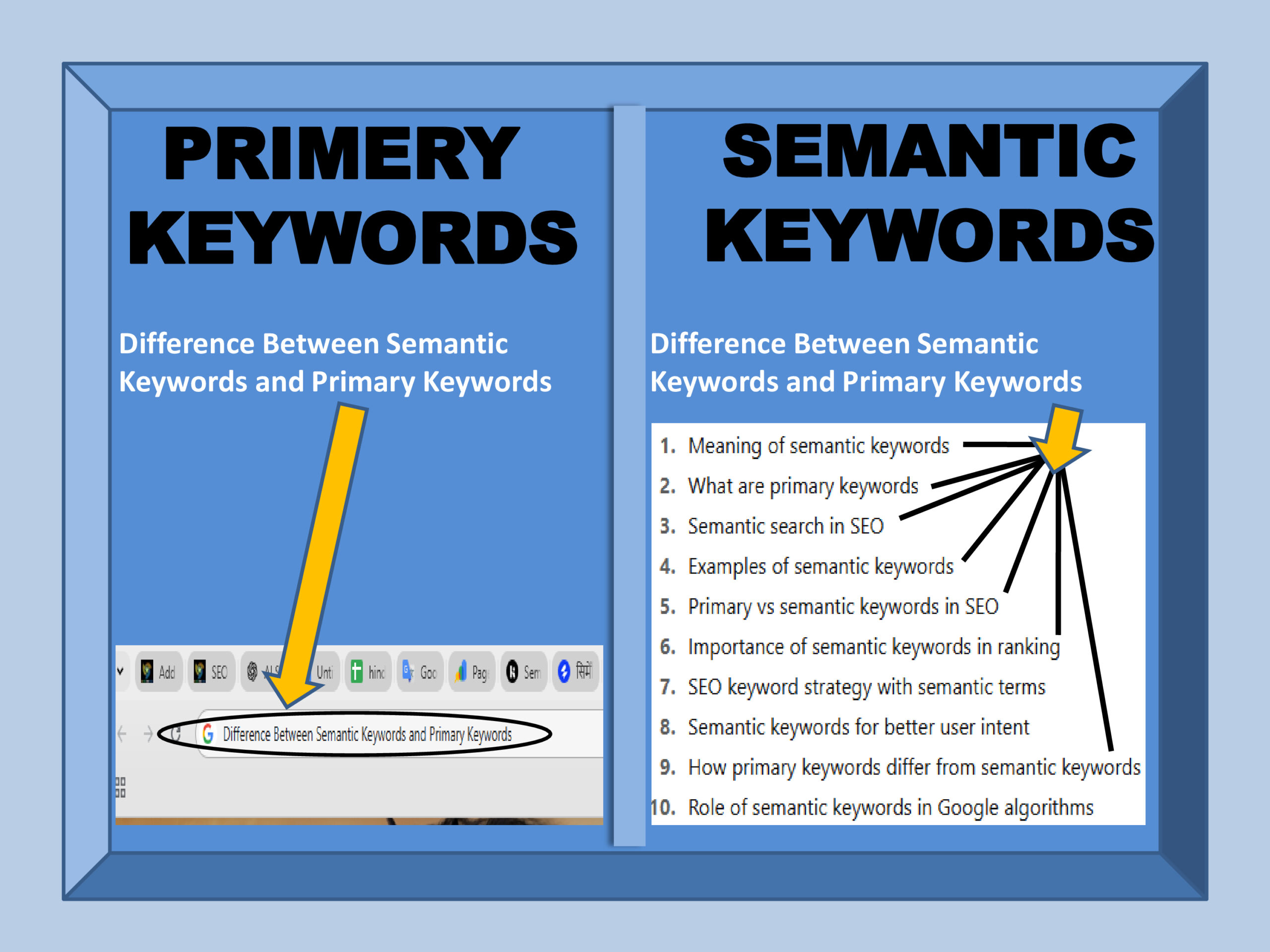
If you are new to blogging or SEO, you’ve probably come across two terms quite often – Primary Keywords and Semantic Keywords. At first, they might sound similar, but in reality, their role and importance in SEO are quite different. Let’s break it down in a simple, conversational way.
1. What Are Primary Keywords?
A primary keyword is the main focus keyword around which your entire article or webpage is built.
- It’s the keyword people are directly searching for on Google.
- Ranking for it can bring direct traffic to your site.
Example:
If you are writing an article on “What is Powerloom?”, then “Powerloom” is your primary keyword.
2. What Are Semantic Keywords?
Semantic keywords are related terms or phrases that add depth and context to your main keyword.
- They help Google understand the topic and meaning of your content better.
- They also make your article more natural and informative for readers.
Example:
If your primary keyword is “Powerloom”, semantic keywords could be – difference between handloom and powerloom, textile industry, machine weaving, loom technology, etc.
3. Key Differences Between Primary and Semantic Keywords
| Point | Primary Keywords | Semantic Keywords |
|---|---|---|
| Focus | Main topic of the content | Supporting and contextual terms |
| Quantity | Usually 1–2 | Multiple (several related words/phrases) |
| SEO Role | Helps you rank directly on search engines | Helps Google understand context and depth |
| User Experience | Targets one specific topic | Provides detailed and natural information |
| Example | “Powerloom” | “Textile industry”, “machine weaving”, “loom types” |
4. Why Do You Need Both?
- If you only focus on primary keywords, your article may look like keyword stuffing.
- Adding semantic keywords makes your content natural, informative, and reader-friendly.
- Google’s algorithm doesn’t rely only on exact matches anymore; it looks at the overall context of your content.
5. Easy Tips to Use Primary and Semantic Keywords Correctly
- Finalize your primary keyword before writing.
- Research related semantic keywords (Google Suggestions, People Also Ask, Related Searches).
- Use the primary keyword in the title, intro, and key headings.
- Sprinkle semantic keywords naturally throughout the article.
- Avoid forcing keywords—keep the flow natural.
In simple words, your primary keyword is the hero of your content, while semantic keywords are the supporting cast. Just like a movie needs a strong team to make the hero shine, your content also needs semantic keywords to give depth, clarity, and context. This way, both Google and readers get the maximum value from your article.
The Role of Semantic Keywords in Search Engine Algorithms
Semantic Keywords are those words or phrases that are not directly the primary keyword but represent related meanings or context. For example, if your main keyword is SEO, then the related Semantic Keywords would be Search Engine Optimization, Google Ranking, Backlinks, On-Page SEO, and Content Optimization. These keywords help Google understand that your content is not limited to just one word but also covers the entire related topic.
In today’s time, search engines have become very smart. Earlier they only focused on exact keywords, but now they understand User Intent, meaning what the user is actually looking for. This is where Semantic Keywords play the most important role. For example, if someone searches – Best phone for photography, Google will not only focus on the word phone but will also understand Semantic Keywords like camera quality, megapixel, low-light photography, and mobile camera features.
When we talk about User Intent, it is of three types – Informational Intent (to gain knowledge), Navigational Intent (to reach a specific brand or website), and Transactional Intent (to buy a product or service). If you use Semantic Keywords correctly in your content, your article will cover all these intents, making it easy for Google to decide which type of users will find your page useful.
Google’s algorithms such as Hummingbird, RankBrain, and BERT are fully based on semantic understanding. Hummingbird focuses on context and meaning, RankBrain uses machine learning to capture the intent of queries, and BERT deeply understands natural language. All these algorithms use Semantic Keywords to determine which content will be most relevant for users.
Using Semantic Keywords in the right way has many benefits. It makes content natural and human-friendly, helps search engines understand the page better, increases the chances of ranking even in high-competition keywords, and most importantly, provides value to the users because the content becomes detailed and relevant.
If you are wondering where to find Semantic Keywords, you can check Google Search’s “People also ask” and Related Searches section. Apart from that, tools like Semrush, Ahrefs, and Ubersuggest can also be very helpful. Nowadays, AI tools are also used to generate context-based Semantic Keywords, which you will learn in detail below.
In conclusion, Semantic Keywords work like a backbone for search engine algorithms. They not only help your content rank but also play a crucial role in reaching the right audience. If you want your website or blog to stay on top for the long term, you must include Semantic Keywords in your SEO strategy.
The Relationship Between Semantic Keywords and User Intent
Semantic Keywords and User Intent have a deep connection. Whenever a user searches on Google, there is always an intention behind it. Google does not just look at the exact word typed by the user, it also tries to understand what the user actually wants to know or achieve. This is where Semantic Keywords play the most important role.
For example, if someone searches – “Best laptop for students”, the main keyword here is laptop. But Google also understands related Semantic Keywords such as budget laptop, lightweight laptop, best battery backup, online classes laptop. With the help of these keywords, Google identifies that the user’s intent is not just to find any laptop, but specifically the most suitable laptop for students.
User Intent is mainly of three types –
- Informational Intent → When the user is only seeking knowledge, like “What is SEO?”
- Navigational Intent → When the user wants to reach a specific brand or website, like “YouTube login”
- Transactional Intent → When the user wants to buy a product or service, like “Buy iPhone 15 online”
Now, if you use Semantic Keywords properly in your content, your article can cover all three types of intent. This not only helps search engines understand your content better but also ensures the user gets the exact information or solution they are looking for.
Google algorithms like RankBrain, BERT, and Hummingbird work based on semantic understanding. They don’t just look at words but also try to understand the meaning behind them. That’s why, if your content matches the User Intent and includes the right Semantic Keywords, your chances of ranking at the top increase significantly.
This creates two big advantages – first, your content becomes stronger in terms of SEO, and second, your visitors have a better experience because they find exactly what they were searching for.
In conclusion, Semantic Keywords and User Intent complement each other. Combining both is the key to a successful SEO strategy. If you want your blog or website to remain at the top of Google for the long term, always focus on understanding user intent and include relevant semantic keywords in your content.
Semantic Keywords vs. LSI Keywords: What’s the Difference?
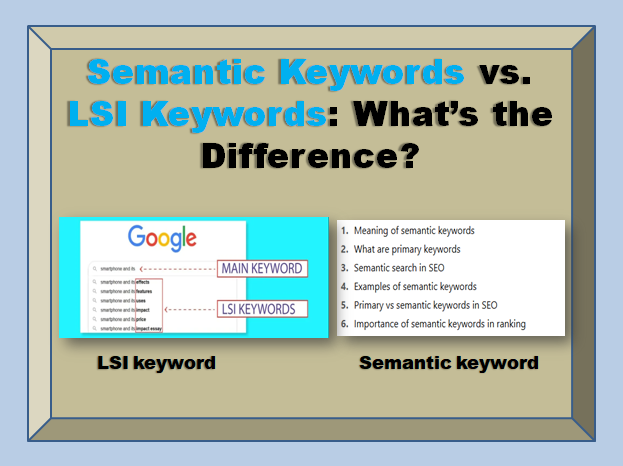
In the world of SEO, two terms often come up – Semantic Keywords and LSI Keywords. Many people assume they are the same, but in reality, there’s a big difference. If you want to do SEO the right way, it’s important to clearly understand the distinction between the two.
Let’s start with Semantic Keywords. These are words or phrases that represent the meaning, context, or concept related to your main keyword. For example, if your keyword is “Digital Marketing”, then the semantic keywords could be SEO, Content Marketing, Social Media Strategy, Paid Ads, and so on. In short, semantic keywords help Google understand that your content is not limited to one keyword but covers the entire topic around it.
Now let’s talk about LSI Keywords (Latent Semantic Indexing Keywords). LSI is an old technique developed in the 1980s for information retrieval systems. Its purpose was to help computers understand synonyms and closely related terms. For example, if the keyword is “Apple”, LSI technology would help determine whether it refers to Apple the fruit or Apple the company. In other words, LSI keywords were designed to clarify context.
However, in today’s world, Google does not use LSI technology. It doesn’t need it because Google has advanced AI-based algorithms (like RankBrain and BERT) that understand natural language and semantic meaning at a much deeper level.
So, what’s the real difference between Semantic Keywords and LSI Keywords?
- Semantic Keywords → These are real and actively used by Google to understand user intent and content context.
- LSI Keywords → This is an outdated concept. While it’s still mentioned in the SEO industry, Google doesn’t actually use LSI anymore.
- Semantic keywords focus on context and relevance, while LSI keywords were limited to synonyms or closely related words.
- If you want to improve your SEO, focus on Semantic Keywords, not LSI keywords. Semantic keywords make your content more natural, user-friendly, and search-engine-friendly. LSI, on the other hand, is more of a myth that still confuses many people in their SEO strategy.
How Does Google Use Semantic Search?
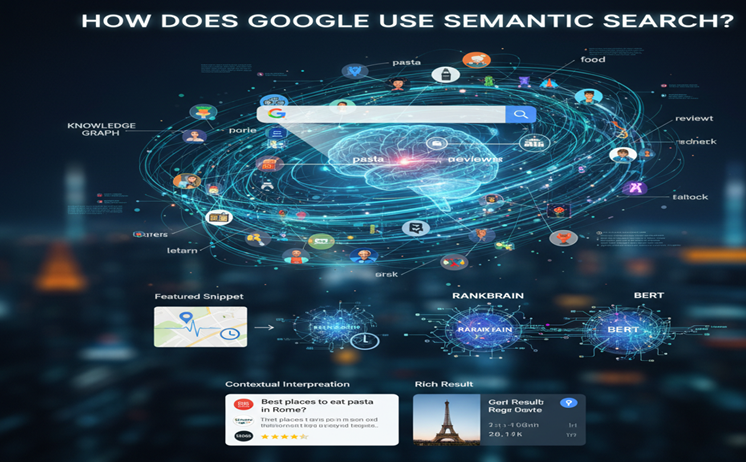
Over the years, Google has launched several algorithms to improve its ability to understand semantics and user intent.
- Hummingbird (2013): This update taught Google to move beyond simple keyword matching and start understanding the actual meaning behind queries.
- RankBrain (2015): An AI-based system that helps Google interpret unfamiliar or completely new queries and deliver the most accurate results.
- BERT (2019): A natural language processing algorithm that analyzes the context of every word in a sentence to better capture user intent.
Thanks to these algorithms, Google can now identify whether a user is looking for informational (knowledge), navigational (reaching a website), or transactional (buying or using a service) results.
Connection Between User Intent and Semantic Search
The biggest advantage of semantic search is its ability to recognize user intent.
- A query like “how to fix slow laptop” shows informational intent.
- A query like “Dell service center near me” reflects navigational intent.
- A query like “buy gaming laptop online” indicates transactional intent.
With semantic search, Google is able to understand these different types of intent and serve the most relevant results accordingly.
Why Is Semantic Search Important?
- Users get faster and more accurate answers.
- Search results are no longer just keyword-based but are centered around the entire topic and context.
- For website owners and content creators, this means success doesn’t come from keyword stuffing anymore. Instead, it’s about creating high-quality, intent-driven content that genuinely addresses users’ needs.
By adopting semantic search, Google and other search engines have completely transformed the online search experience. Users now find exactly what they’re looking for, while creators have the opportunity to deliver content that is both relevant and valuable.
If you’re into SEO or blogging, understanding semantic search and focusing on user intent is the ultimate key to long-term success.
How to Identify Semantic Keywords Manually
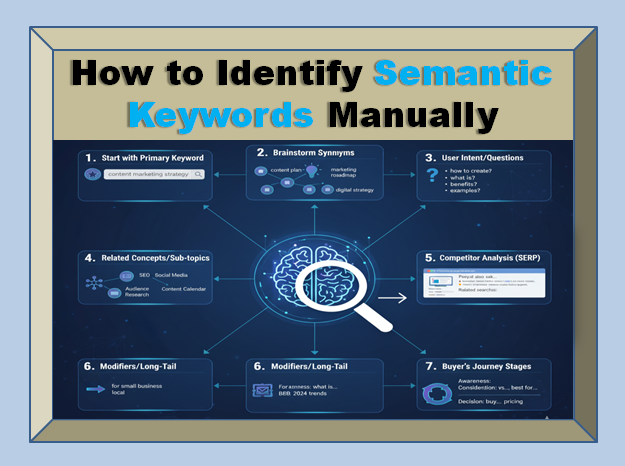
Most people rely on SEO tools or AI for keyword research, but you can also find semantic keywords manually if you know where to look. Manual research helps you think like your target audience and create content that aligns with real user intent.
Most people rely on SEO tools or AI for keyword research, but you can also find semantic keywords manually if you know where to look. In fact, combining AI with manual keyword research gives you the best results—AI speeds up the process while manual research helps you think like your target audience and create content that aligns with real user intent.
1. Google Search Suggestions (Autocomplete)
When you type a query into Google, it instantly shows suggestions in the dropdown.
Example: Type “digital marketing” → you’ll see suggestions like “digital marketing strategy,” “digital marketing tools,” “digital marketing jobs.”
These are semantic variations of your main keyword.
2. “People Also Ask” Box
On almost every search result page, you’ll find the People Also Ask (PAA) section.
For example, if your keyword is “SEO,” you might see:
- “What is SEO and how it works?”
- “Is SEO better than PPC?”
These related questions show what users are actually curious about—perfect semantic keywords to include.
3. Related Searches at the Bottom of Google
Scroll down after searching a term, and you’ll find “Related Searches.”
Example: For “content writing”, related searches may include:
- “SEO content writing tips”
- “freelance content writing jobs”
- “content writing examples”
All of these are semantic keyword ideas.
4. Analyze Competitor Content
Look at the top 5 ranking pages for your main keyword. See what phrases, subheadings, and recurring words they use.
For instance, for “healthy recipes,” you’ll often notice words like “low carb,” “nutritious,” “meal prep,” “diet-friendly.”
These are semantic terms you should also cover.
5. Use Synonyms and Contextual Words
Think like your reader.
If your main keyword is “laptop,” users might also use words like “notebook,” “computer,” “device,” “portable PC.”
Adding these variations helps your content feel natural and cover broader search queries.
6. Check Forums and Communities (Quora, Reddit, Niche Forums)
Real people ask real questions here. For example, on Quora if someone asks “How can I make my website load faster?” → related terms include “site speed,” “page performance,” “optimize images,” “reduce server load.”
These can become your semantic keyword set.
7. Wikipedia & Glossaries
Wikipedia pages are a goldmine. Search your keyword there and check the Table of Contents, links, and synonyms used.
Example: For “Artificial Intelligence,” you’ll see terms like “machine learning,” “neural networks,” “automation.”
Manually finding semantic keywords is about thinking like your audience and exploring different sources like Google, forums, competitor sites, and Wikipedia. Unlike automated tools, manual research gives you context-rich, intent-driven phrases that truly connect with users.
If you consistently practice this, you’ll naturally start spotting semantic keywords every time you read, search, or write online.
How to Automatically Generate Semantic Keywords with AI (Including Prompt Ideas)
Why Are Semantic Keywords Important?
Semantic keywords help Google understand not just the exact keyword but also the context and user intent behind a search query. They make your content sound natural, human-friendly, and more relevant to users—while also boosting SEO rankings.
How to Generate Semantic Keywords with AI
1. Start with a Seed Keyword
Enter your primary keyword into an AI tool (like ChatGPT, Surfer SEO, SEMrush, or Clearscope).
Example: “Digital Marketing” → AI suggests: SEO strategies, content writing, social media campaigns, PPC ads.
2. Identify User Intent
AI can categorize queries into different intents:
- Informational → “How to start digital marketing?”
- Navigational → “Neil Patel digital marketing blog”
- Transactional → “Buy digital marketing course online”
3. Build Topic Clusters
Instead of just single keywords, AI creates topic clusters around your keyword.
Example: “Healthy Lifestyle” → Nutrition, workout routines, stress management, sleep habits.
How to Use Prompts for Generating Semantic Keywords
The secret to effective AI-driven keyword research is writing the right prompt. The better your prompt, the better the keyword ideas AI will generate.
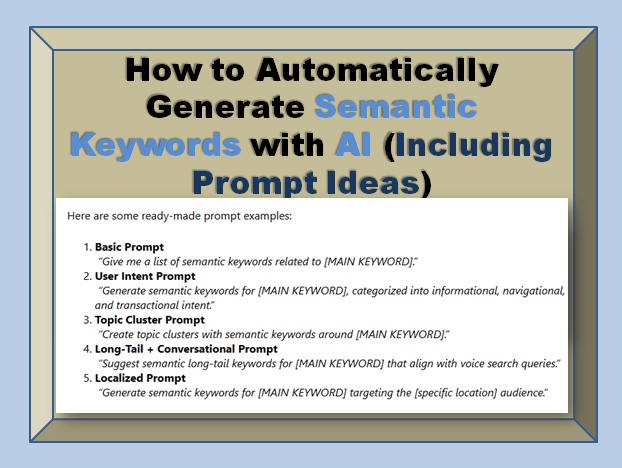
Here are some ready-made prompt examples:
- Basic Prompt
“Give me a list of semantic keywords related to [MAIN KEYWORD].” - User Intent Prompt
“Generate semantic keywords for [MAIN KEYWORD], categorized into informational, navigational, and transactional intent.” - Topic Cluster Prompt
“Create topic clusters with semantic keywords around [MAIN KEYWORD].” - Long-Tail + Conversational Prompt
“Suggest semantic long-tail keywords for [MAIN KEYWORD] that align with voice search queries.” - Localized Prompt
“Generate semantic keywords for [MAIN KEYWORD] targeting the [specific location] audience.”
AI makes semantic keyword generation faster, smarter, and intent-driven. But the real power lies in the prompts you use. With the right prompts, you can:
- Extract better keyword variations
- Cover multiple user intents
- Build topic clusters
- Align content with voice and local searches
In short, prompts are the key that unlocks AI’s full potential for semantic keyword research.
FAQs on AI-Generated Semantic Keywords
1. What are semantic keywords in SEO?
Semantic keywords are contextually related terms and phrases connected to your main keyword. They help search engines understand the full meaning of your content, not just individual keywords.
2. How does AI generate semantic keywords?
AI analyzes your seed keyword, looks at search intent, related terms, and language patterns, then suggests context-rich variations. It often uses natural language processing (NLP) to provide accurate keyword ideas.
3. Why should I use AI instead of manual research?
Manual research (Google suggestions, competitor analysis, forums) takes time. AI automates the process, saves hours of work, and provides more comprehensive, intent-driven, and up-to-date keyword suggestions.
4. Can AI detect different user intents in keyword research?
Yes . AI can classify keywords into informational, navigational, and transactional categories, ensuring your content aligns with what users actually want.
5. How do prompts help in AI-driven keyword generation?
Prompts act as instructions you give to AI. A clear, specific prompt helps AI generate more accurate and targeted semantic keywords. For example: “Generate semantic keywords for digital marketing focused on informational intent.”
6. Are AI-generated semantic keywords reliable for SEO?
Yes. While AI-generated keywords are reliable, they work best when combined with manual validation (checking search volume, competition, and trends). AI gives you ideas; SEO strategy comes from how you use them.
7. What is the future of AI in semantic keyword research?
The future is real-time, personalized keyword generation. AI will adapt to user behavior, location, and search trends instantly—making SEO more dynamic and less dependent on traditional keyword lists.
Start using AI-powered semantic keyword research today and create content that truly matches user intent, context, and search trends.
Whether you’re a blogger, marketer, or business owner, the right keywords can help you rank higher, attract the right audience, and grow faster.
Don’t just focus on keywords—focus on meaning. Try AI-driven tools and see the difference in your content strategy!