
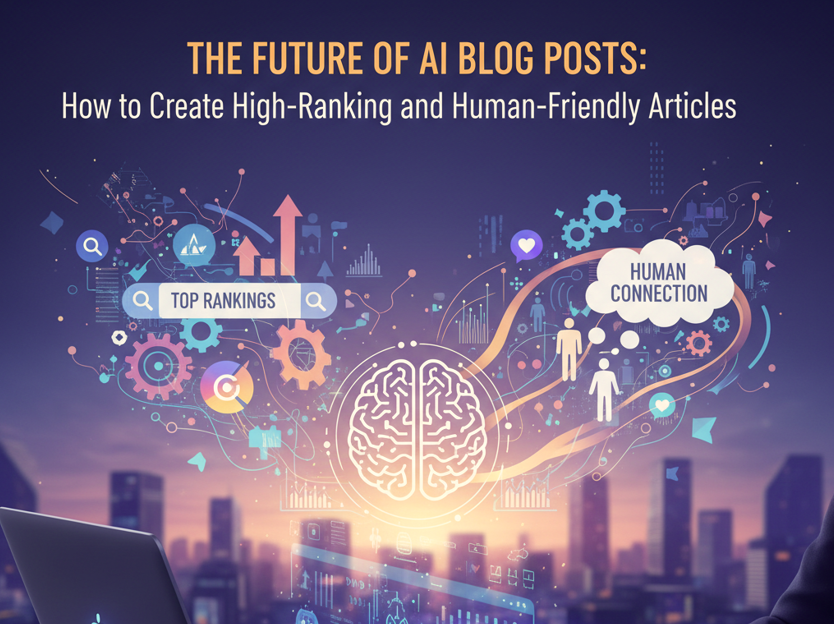
In the era of AI-driven content creation, understanding user intent has become more important than ever. Whether you’re writing manually or using AI tools, your success depends on how well your content satisfies what the reader is truly looking for. User intent isn’t just about the keywords — it’s about the purpose behind every search and how effectively your content fulfills it.
When someone searches for “AI blog post,” their intentions can be completely different. One user might want to understand what an AI blog post is, another might be interested in how to earn from AI blogging, while a third may want to learn how to write SEO-optimized content using AI tools. This variety shows that the same keyword can carry multiple intents — informational, commercial, or even transactional.
To create a successful AI blog post, you must first identify this intent. Before writing, ask yourself — What does my target reader want to achieve with this search? Once you know that, you can structure your content accordingly.
AI tools like ChatGPT, Jasper, and Frase.io can assist in generating outlines, headings, and SEO suggestions, but they can’t fully understand human psychology or emotion. That’s where your creativity steps in. Combine AI’s analytical power with your emotional intelligence to produce content that both Google and readers love.
For example, if your readers are searching with informational intent, focus on detailed guides and step-by-step explanations. If their intent is commercial, include comparisons, pros and cons, and honest recommendations. For transactional intent, highlight offers, CTAs, and purchase links clearly. Matching your content type to user intent ensures your post is relevant, useful, and conversion-friendly.
What most bloggers get wrong is depending entirely on AI. They use common prompts like “Write a blog on this keyword,” which results in repetitive, generic content. Search engines can detect such similarity and rarely rank it high. The real trick lies in crafting unique, intent-driven prompts and refining AI-generated content with your personal insights, examples, and experiences.
In short, user intent is the foundation of AI blogging success. AI may write your words, but understanding why those words matter to your readers — that’s the real game-changer. When your blog aligns perfectly with user intent, it not only ranks higher but also builds trust, engagement, and authority — the true pillars of a long-term blogging career.
What is an AI Blog Post and How Does It Work?

If I told you that you no longer need to spend hours writing a blog post, it might sound surprising — but it’s true!
Today, writing an AI Blog Post has become a smart, simple, and time-saving process.
Let’s understand what exactly an “AI Blog Post” is and how it actually works for us.
First, let’s agree on one thing — writing a good blog isn’t just about putting words together.
It involves research, SEO, tone, emotion, and structure — everything must work in harmony.
Earlier, humans used to handle all of this alone, but now Artificial Intelligence (AI) helps us get it all done within minutes.
When you enter a topic or keyword into an AI writing tool (like ChatGPT, Jasper, Writesonic, or Copy.ai),
the tool analyzes millions of data points available on the internet and generates a relevant, well-structured, and SEO-friendly draft for you.
That means you no longer need to start from scratch or write every line manually.
For example —
If you want to write about “How to write an AI blog post”, AI can instantly give you:
- A complete blog outline
- Suggested headings and subheadings
- SEO keywords
- And even a pre-optimized draft
Now, the real question is — How does AI actually work?
AI is a language model trained on millions of articles and web pages.
When you give it a prompt, it predicts what the next words should be based on learned patterns.
This way, it creates a complete paragraph or article that feels both natural and relevant.
But here’s an important truth —
AI only assists you; it doesn’t replace your creativity.
AI provides direction, but emotion, personalization, and storytelling still come from humans.
If you want your blog to rank on Google and connect with readers emotionally,
you need to review AI-generated content and add your own thoughts, experiences, and voice.
So, in simple terms —
AI Blog Post = Human Idea + AI Speed + Human Emotion
That means blogging is now easier, faster, and more effective than ever before.
With AI’s help, you and I can create content that not only Google loves —
but also truly connects with readers.
Why the Future of Blogging Depends on AI
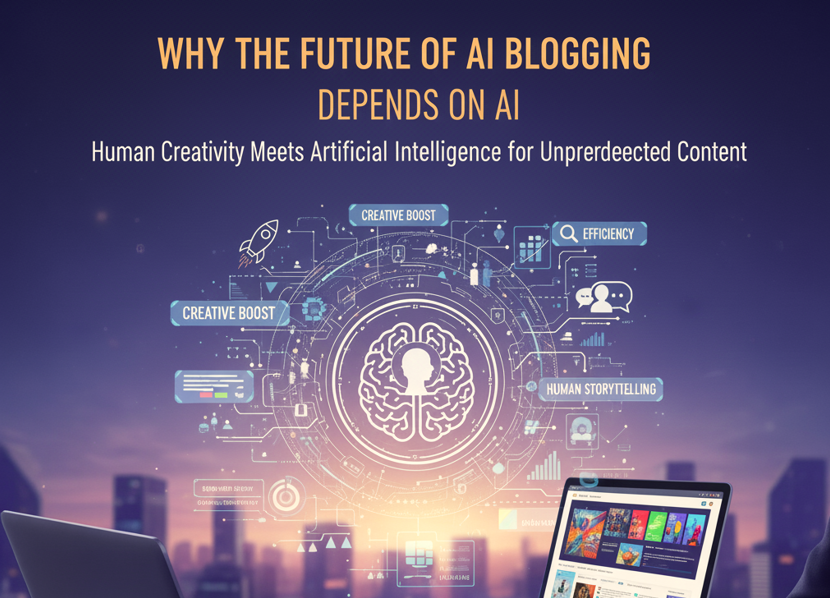
Have you ever wondered how blogging, which once took hours to complete, can now be done in just a few minutes?
It’s not magic — it’s the power of AI (Artificial Intelligence).
You and I both know that blogging is no longer just about writing words — it has become a strategic and data-driven process.
And that’s exactly why the future of blogging is rapidly becoming AI-dependent.
When we talk about blogging, there are three key elements to remember:
Content Creation
SEO Optimization
Audience Engagement
Earlier, all these tasks were done manually — we used to research, find keywords, create headings, and then proofread everything.
But now, AI tools can do all of this within seconds.
You simply enter a keyword, and AI instantly gives you a title, outline, meta description, and even a complete draft.
This means you can now spend more time improving your content and focusing on your strategy instead of starting from scratch.
Now, just imagine — if blogging has already become this fast and smart, what will the future look like?
AI will not only make blogging easier but also more personalized and predictive.
In the future, AI will understand your audience’s behavior —
which topics get more clicks, which headlines attract more attention,
and at what time publishing content brings in the most traffic.
In other words, blogging will evolve from simple content creation to intelligent data-driven storytelling.
However, I strongly believe that while AI is the future of blogging, it doesn’t mean humans will become irrelevant.
AI provides speed and accuracy,
but creativity, emotion, and storytelling are the things that only humans can bring.
Even Google’s algorithms now recognize the importance of a human touch in content.
So, if we want to grow our blogging career,
we need to embrace AI as a partner, not a competitor.
Because in the coming years, the most successful bloggers will be those who combine the power of AI with their own ideas and creativity.
How AI Tools Are Transforming the World of Content Writing

If I told you that today a writer can create a complete article — without getting tired, without making mistakes, and in just a few minutes —
you’d probably ask, “Is that really possible?”
And my answer would be — Yes, absolutely!
Because AI tools have completely revolutionized the world of content writing.
We all know that content writing isn’t limited to just “writing words.”
It includes multiple stages — research, structure, SEO optimization, tone matching, and proofreading.
Earlier, all of this had to be done manually, but now AI tools automate and optimize every step of the process.
That means content creation has shifted from “hard work” to “smart work.”
You, I, and most of us have heard of some popular AI tools —
like ChatGPT, Jasper.ai, Copy.ai, Writesonic, SurferSEO, Grammarly, and Frase.io.
But do you know that these tools don’t just write — they actually think?
Let’s understand how
1. ChatGPT – Your Smart Writing Partner
ChatGPT is an AI writer that generates natural, human-like content based on your prompts.
You simply provide a topic, and it gives you — an outline, headings, introduction, FAQs, and even a conclusion!
I personally use it every day, and honestly, my productivity has doubled.
2. Jasper.ai – Perfect for Marketing and Blogging
If you’re a digital marketer, Jasper is one of the best tools you can use.
It creates SEO-friendly blog posts, product descriptions, and ad copies in a professional tone — ideal for both businesses and creators.
3. SurferSEO – The King of SEO
SurferSEO takes your content strategy to the next level.
It helps you identify high-value keywords, shows what your competitors are ranking for,
and analyzes how well your content is optimized for Google.
4. Grammarly & Hemingway – The Writing Polishers
These tools make your content error-free and reader-friendly.
Grammarly checks grammar, tone, and sentence structure,
while Hemingway improves readability by simplifying complex text.
Now, just think about it —
where it once took a blogger 3–4 hours to complete one article,
today, the same work can be done in just 30 minutes —
and the quality is even better than before!
AI tools have given us the perfect combination of speed, accuracy, and creativity.
Writers can now focus more on content strategy and brand voice, rather than spending hours on manual work.
In short, you and I are no longer just writers — we’ve become AI-assisted creators.
And in the near future, these tools will become even smarter —
they won’t just write content but will also auto-optimize it based on audience behavior.
As we’ve seen in earlier sections —
the future of blogging and content writing is now completely AI-powered and data-driven.
How to Use AI for a High-Ranking Blog Post
If you want your blog to rank higher on Google and reach the right audience,
then simply writing good content is no longer enough — you need to write smartly with the help of AI.
In this post, you and I will explore how to use AI to create high-ranking blog posts.
You’ll learn how AI tools help you with keyword research, SEO optimization, meta titles and descriptions,
and how they make your content both reader-friendly and Google-friendly.
This guide isn’t just about technical tricks —
it’s about understanding how to use AI as a partner, not a shortcut.
Because in blogging, success belongs to those who combine AI’s speed with human creativity.👉 If your goal is to boost your blog’s ranking, traffic, and engagement,
then this article is exactly what you need — let’s discover how AI can take your blogging strategy to the next level.
How to Create Human-Friendly Articles — Write for Readers, Not Just Robots

Let’s be honest — many of us, including you and me, have used AI to write articles. It’s fast, convenient, and helps us produce content in minutes.
But here’s the real truth: most AI-generated articles sound robotic, emotionless, and repetitive.
And do you know what happens then?
Google’s algorithm analyzes such content — and if it looks like a machine-written, low-engagement article, it either ranks lower or doesn’t rank at all.
That’s why today’s blogging strategy is not about writing “AI-based articles,” but about creating “AI + Human-optimized articles.”
Your goal should be to write for Google and readers — both.
Now let’s understand how you can use AI smartly and make your articles truly human-friendly 👇
Step 1: Use AI for Structure, Not for Final Output
When you use AI tools like ChatGPT, Jasper, or Writesonic — don’t copy their first draft directly.
Use AI only for ideas, outlines, headings, or keyword suggestions.
Then, add your own experience, real-life examples, and natural tone to make it sound genuine.
Example prompt:
“Write an article on [topic] that sounds natural, conversational, and emotionally engaging — as if a human writer is talking directly to the reader.”
This kind of prompt guides AI to create content that’s smoother and reader-focused.
Step 2: Add Human Emotion and Storytelling
Readers connect with emotions, not data.
So once AI gives you a draft, personalize it — add your thoughts, small stories, real experiences, and conversational phrases like “you,” “let’s,” “imagine this,” etc.
This helps your content feel alive, relatable, and trust-worthy.
Step 3: Optimize for Google, Not Over-Optimize
AI can help with SEO — keywords, meta titles, and headings — but overdoing it makes your content feel fake.
Keep the keyword density natural and focus more on value, clarity, and readability.
Remember, Google’s latest algorithms (like Helpful Content Update) reward content written for humans, not robots.
Step 4: Rephrase and Humanize AI Output
After generating AI text, always edit it in your own voice.
You can use tools like Grammarly, Hemingway, or even ChatGPT (with humanization prompts) to make the text flow naturally.
Example prompt:
“Make this paragraph sound more human, emotional, and engaging — suitable for a blog audience.”
Step 5: Balance — AI Efficiency + Human Creativity
AI saves time, but humans add soul.
Use AI for speed and accuracy, but keep tone, emotion, and creativity in your hands.
That’s how your article will rank on Google and touch readers’ hearts.
Final Thought
AI is a powerful writing partner, but not a replacement for human thinking.
If you want your article to perform well — it must be written for readers first, and optimized for search engines second.
So next time you write with AI, remember:
“Don’t just create an article for robots — write something your readers will feel.”
Because that’s what makes a blog truly human-friendly and high-ranking.
AI vs Human Writer: Who is the Better Blogger?
A Comparison and Why Combining Both is the Most Effective Solution

A Comparison and Why Combining Both is the Most Effective Solution
If I ask you — “Who will be the best blogger in the future — AI or a human?”
Your answer might be either:
“AI, because it’s fast and smart,”
or “Human, because they’re creative and emotional.”
But the truth is deeper than that —
The future belongs to those who know how to combine the strengths of both.
1. AI Writer — The King of Speed and Data
AI writing tools like ChatGPT, Jasper, Writesonic, or Copy.ai have taken content creation to a new level.
The biggest advantage of AI is speed and accuracy.
You provide a topic or keyword, and within seconds,
AI can generate headlines, outlines, meta descriptions, and even a complete draft.
Key strengths of AI:
- Writing content in minutes
- Assisting with SEO optimization
- Maintaining grammar, tone, and structure
- Producing keyword-based content efficiently
But AI has its limits — it cannot feel emotions, understand human experiences, or create the deep storytelling that a human can.
2. Human Writer — The Master of Creativity and Connection
Humans have a power that no algorithm can replicate —
emotion, experience, and imagination.
A human writer can make content more engaging and relatable using personal experiences, culture, and perspective.
Key strengths of humans:
- Emotional storytelling and authentic tone
- Deep understanding of audience psychology
- Representing brand voice naturally
- Generating fresh ideas and unique perspectives
Limitations of humans:
- Fatigue and slower writing
- Time-consuming research
- Maintaining consistency can be challenging
3. So, What’s the Verdict?
Now we can see clearly —
AI and Human are not competitors, they are partners.
If AI provides speed and SEO power,
humans provide creativity and emotional depth.
AI + Human = The Perfect Blogging Formula
In this combination:
- AI handles research, keyword planning, and draft creation
- Humans personalize, edit, and make it emotionally powerful
Blogging today is no longer just “smart work,” it’s “smart + heartfelt work.”
Final Thought
The most successful blogger of the future will neither rely solely on AI
nor ignore AI completely.
It will be someone who combines AI’s efficiency with human empathy.
Because when machine speed meets human heart,
you get content that pleases Google and resonates deeply with readers.
Pros and Cons of AI Blog Posts
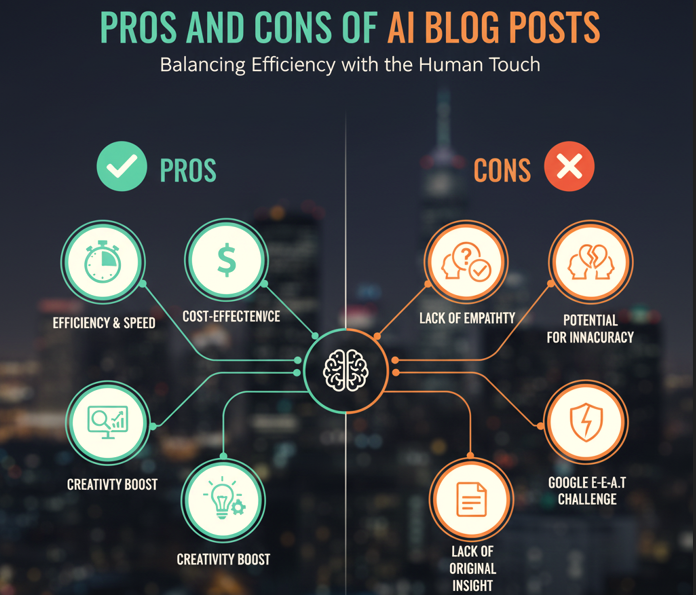
“Here is the Pros & Cons of AI Blog Posts written in column format for you:Pros | Cons”
| Pros | Cons |
| Fast and Easy Content Creation: AI can draft a blog in minutes.Example: If you need a blog on “AI Blogging Tools,” AI can generate the full outline and content in a few seconds. | Lack of Keyword Context: Writing a blog directly on any keyword is unwise because AI cannot fully understand what the correct content should be for that topic or keyword.Example: AI can create generic content on “Best SEO Tips” but may not match the intent of a niche audience. |
| Helps with SEO Optimization: AI can suggest keywords, headings, meta descriptions, and internal linking.Example: AI can automatically suggest H1, H2, and focus keywords. | Attention to Content Length: AI blogs have no strict word limit, but use only as many words as required to satisfy user intent.Example: If the article is too long and filled with irrelevant info, users may get bored and leave the site. |
| Consistency and Grammar: AI always produces structured and error-free content.Example: Grammar and punctuation mistakes are almost nonexistent, making content appear professional. | Lack of Human Touch: AI content can feel robotic and emotionless, weakening reader connection.Example: Storytelling, examples, and personal experiences cannot be added by AI alone. |
| Content Scaling: Multiple blog posts can be created quickly at a large scale.Example: If you have 10 different topics, AI can draft them in just a few minutes. | Risk of Over-dependence: Relying only on AI can harm creativity and originality.Example: If you always use AI for content, your brand voice and unique ideas may get diluted. |
| Saves Time and Effort: Using AI for research and initial drafting allows writers to invest more time in editing and strategy. | Quality vs. Quantity Risk: AI can generate unlimited content, but quality is not always guaranteed.Example: If content is purely keyword- and SEO-focused, readers may not engage. |
How to Create a Perfect Blog Using AI by Understanding User Intent
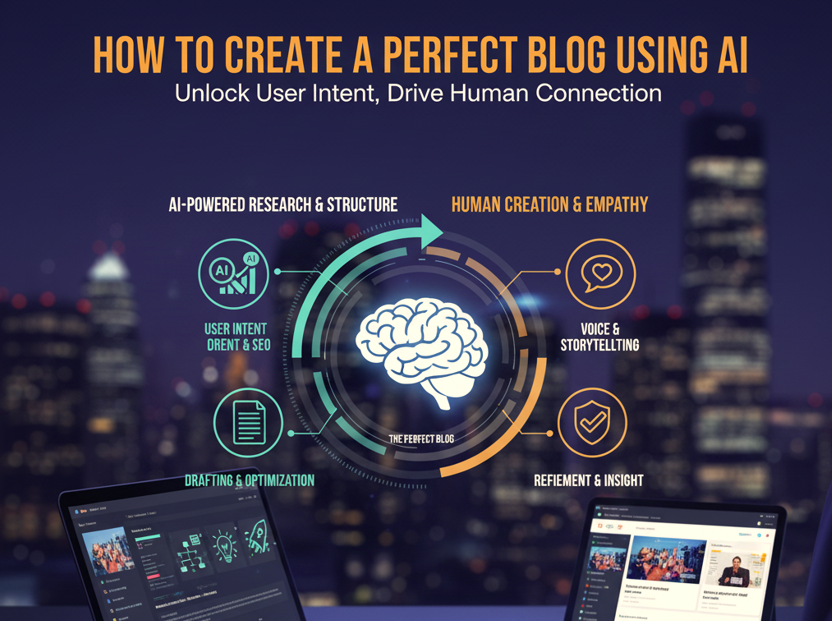
Creating a blog with AI isn’t just about generating content; it’s about aligning that content with what users are actually searching for. To make the most of AI, you need to understand user intent—the reason behind a search query. User intent can be informational (looking for knowledge), navigational (trying to find a specific site), transactional (ready to buy), or commercial investigation (researching before a purchase).
Once you identify the type of intent, you can guide AI to produce content that truly satisfies your audience. For example, if the intent is informational, prompt AI to create detailed guides, examples, and step-by-step explanations. If the intent is transactional, AI should focus on product comparisons, benefits, and calls-to-action.
A good strategy includes:
- Keyword Analysis with Intent: Identify keywords and understand whether the user is looking for information, solutions, or products.
- Clear AI Instructions: Provide AI with context about the target audience, tone, and type of content required.
- Content Structuring: Ask AI to create a logical structure—headings, subheadings, bullet points—that matches how users consume information.
- Examples and Case Studies: Incorporate real-life examples to make the content relatable and actionable.
- Review and Optimize: Even after AI generates content, review it to ensure it fully addresses user intent, flows naturally, and maintains quality.
By combining AI capabilities with a clear understanding of user intent, you can create blogs that are not only fast and scalable but also highly engaging and relevant to your audience.
Conclusion:
The use of AI has brought a revolution in blogging. It not only makes content creation faster and easier but also helps in making blogs SEO-friendly and well-structured. With AI, you can create content at scale, save time and effort, and consistently publish high-quality blogs.
However, AI-generated content also has certain limitations. It may lack emotional connection, creativity, and personal experiences. Relying solely on AI can make your blog feel robotic and impersonal. Therefore, it is essential to always add a human touch and edit content according to user intent.
A successful AI blogging strategy should include:
- Understanding the right keywords and user intent,
- Giving AI clear instructions and defining content structure,
- Including real-life examples and case studies,
- And finally, reviewing and optimizing the content.
When AI capabilities are combined with human intelligence, the results are not only fast and scalable but also useful, engaging, and relevant to the audience.
In summary, AI blogging can be considered a powerful tool, but using it smartly along with a human perspective is the true key to success.
FAQs About AI Blog Writing
1. What is AI blog writing?
AI blog writing is the process of using artificial intelligence tools to generate blog content, including outlines, drafts, and even optimized SEO elements.
2. Can AI understand user intent?
AI can partially understand user intent if you provide clear instructions and context, but human guidance is essential for accuracy and engagement.
3. Is AI-generated content SEO-friendly?
Yes, AI can suggest keywords, meta descriptions, headings, and internal links, making content optimized for search engines.
4. Can AI replace a human content writer?
AI can assist and speed up content creation but cannot fully replace a human writer because it lacks creativity, storytelling, and emotional connection.
5. How fast can AI generate a blog?
Depending on the complexity, AI can generate a full blog outline and draft in a few minutes, which is much faster than manual writing.
6. What are the main pros of AI blogging?
- Fast content creation
- Consistent grammar and structure
- Easy SEO optimization
- Scalable for multiple topics
7. What are the main cons of AI blogging?
- Lacks human touch and emotional engagement
- May produce generic content if not guided properly
- Over-reliance can dilute brand voice
- Quality is not guaranteed without review
8. How can I make AI content more engaging?
Add human touch by including personal stories, examples, case studies, humor, and insights that AI cannot generate on its own.
9. Can AI help with keyword research?
Yes, AI tools can suggest high-traffic keywords, related terms, and content structure to match search intent.
10. What is the best way to use AI for blogs?
Combine AI efficiency with human oversight: clearly define user intent, provide instructions, structure content, and review before publishing to ensure quality and relevance.
“Ready to take your blogging to the next level? Start leveraging AI today to create high-quality, engaging, and SEO-optimized blogs in minutes! Don’t wait—combine AI efficiency with your unique human touch and watch your content reach new heights. Try it now and transform your blogging strategy!”