Artificial Intelligence is evolving rapidly, and single AI tools are no longer enough for complex tasks. Today, multi-agent systems are used to automate complex workflows at scale. In this space, CrewAI Agents has emerged as a powerful framework that enables multiple AI agents to work together collaboratively.
In the CrewAI framework, every agent plays a specific role, performs tasks, uses tools, and collaborates with other agents. This makes it possible to automate complex workflows with ease.
In this article, we will explore what CrewAI Agents are, how they work, how to build them, and their real-world use cases in detail.
What Are CrewAI Agents?
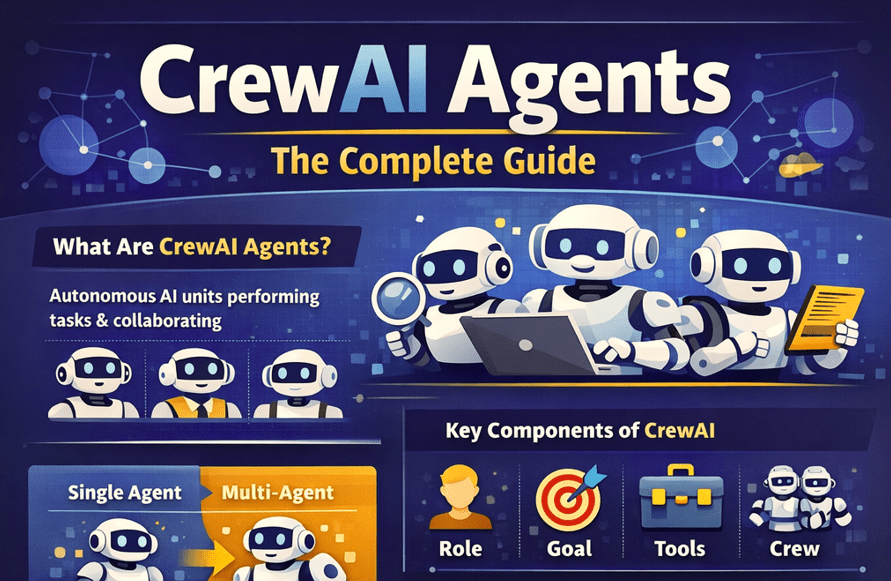
CrewAI Agents are autonomous AI agents that perform tasks based on specific goals and roles.
Every agent is given a few key things:
- Role – the function the agent performs
- Goal – the objective the agent is working toward
- Backstory – background context that helps the agent reason better
- Tools – the tools the agent can use
Based on all of these, the agent makes intelligent decisions and completes tasks.
How CrewAI Agents Work in AI Automation
CrewAI Agents operate under a structured workflow in automation.
The process works like this:
- Agents are created first.
- Each agent is assigned a role and goal.
- Tasks are defined.
- Agents execute the tasks.
- When needed, agents collaborate with each other.
In this way, multiple agents work together to manage a complex system.
CrewAI vs Traditional AI Bots: Key Differences
Traditional AI bots typically operate on simple commands, while CrewAI Agents are far more advanced.
| Traditional Bots | CrewAI Agents |
|---|---|
| Single task focus | Multi-agent collaboration |
| Limited reasoning | Advanced reasoning |
| Manual workflows | Automated workflows |
| Limited tools | Multiple tool integration |
Core Components of CrewAI Agents
There are a few core components needed to build CrewAI agents:
- Agent – the AI unit that performs tasks
- Task – the specific work an agent needs to do
- Crew – a group of agents
- Process – the workflow execution method
- Tools – external integrations
All of these components together form a multi-agent ecosystem.
Role, Goal and Backstory in CrewAI Agents
In CrewAI, agents are given context to perform better.
- Role: What the agent will do.
- Goal: What the agent’s objective is.
- Backstory: Background context that allows the agent to reason more effectively.
This system makes agents significantly more intelligent.
Types of CrewAI Agents You Can Build
You can build different types of agents in CrewAI, such as:
- Research Agent
- Content Writer Agent
- Data Analyst Agent
- Coding Assistant Agent
- Marketing Automation Agent
Each agent operates within a specific domain.
Single Agent vs Multi-Agent Systems
In a single agent system, only one AI model works at a time. In a multi-agent system, multiple agents collaborate to perform tasks together.
Advantages of multi-agent systems:
- Better collaboration
- Complex task automation
- Higher scalability
- Better task delegation
How CrewAI Agents Collaborate in a Crew
In CrewAI, agents work like a team. For example:
- Research Agent → collects data
- Writer Agent → prepares content
- Editor Agent → optimizes the content
In this way, the entire workflow becomes automated.
Understanding Crews in CrewAI
A Crew means a group of agents working toward a common goal.
A Crew consists of:
- Multiple agents
- Defined tasks
- An execution process
In the CrewAI framework, crews efficiently manage complex projects.
Tasks and Workflows in CrewAI Agents
Defining tasks in CrewAI is essential.
A task includes:
- Task description
- Expected output
- Assigned agent
Workflows can be sequential or hierarchical.
CrewAI Agents Architecture Explained
CrewAI architecture is based on a multi-layer system.
Main layers:
- Agents Layer
- Task Layer
- Process Layer
- Tool Integration Layer
This architecture helps build a scalable automation system.
Step-by-Step Guide to Creating a CrewAI Agent
The process for creating a CrewAI agent:
- Install the CrewAI library
- Define the agent
- Define tasks
- Create a crew
- Run the workflow
This way, you can build an automated system.
Installing CrewAI and Setting Up the Environment
A Python environment is required to install CrewAI.
Installation command:
bash
pip install crewaiAfter this, API keys and dependencies need to be configured.
Creating Your First CrewAI Agent with Python
A basic agent can be created using Python:
- Define the role
- Define the goal
- Attach tools
After that, the agent is added to a crew and run.
Creating CrewAI Agents Using YAML Configuration
CrewAI also supports YAML configuration. Agents and tasks can be defined in a YAML file. This keeps the project structure more organized.
Important Parameters Used in CrewAI Agents
Some important parameters in CrewAI agents include:
- role
- goal
- backstory
- tools
- memory
- verbosity
These parameters control agent behavior.
Tools That CrewAI Agents Can Use
CrewAI agents can use many tools, such as:
- Web search tools
- APIs
- Databases
- Python functions
- Custom tools
Tools help agents access real-world data.
Enabling Memory in CrewAI Agents
Memory gives agents the ability to remember previous context.
With memory, agents can:
- Understand past interactions
- Give better responses
- Manage long workflows
Reasoning and Planning Capabilities of CrewAI Agents
CrewAI agents come with reasoning and planning abilities. This helps agents solve complex problems effectively.
How CrewAI Agents Handle Context Windows
Large Language Models have context window limitations. CrewAI agents use context management techniques to generate efficient responses within those limits.
Allowing Agents to Delegate Tasks
CrewAI agents can also delegate tasks to other agents. This makes the workflow more efficient overall.
CrewAI Agent Communication and Collaboration
Agents share information through communication. This collaboration is the greatest strength of multi-agent systems.
CrewAI Agents Workflow Example
An example workflow:
- Research Agent collects data
- Analyst Agent analyzes the data
- Writer Agent creates a report
The entire workflow is automated in this manner.
Real-World Use Cases of CrewAI Agents
CrewAI agents are being used across many industries:
- Business automation
- AI research
- Marketing
- Software development
Using CrewAI Agents for Research Automation
Research agents automatically:
- Perform web searches
- Collect data
- Prepare summaries
This is extremely useful for researchers.
Using CrewAI Agents for Content Creation
Content creation workflow:
Research Agent → Writer Agent → Editor Agent → SEO Optimizer
This can automate an entire blogging process.
Using CrewAI Agents for Customer Support
AI support agents can:
- Handle FAQs
- Solve customer queries
- Manage support tickets
Using CrewAI Agents for Business Automation
Businesses can use CrewAI agents for:
- Report generation
- Email automation
- Analytics
CrewAI Agents for Data Analysis and Reporting
Data analysis agents can:
- Analyze datasets
- Extract insights
- Generate reports
Building a Marketing Automation System with CrewAI Agents
In marketing automation, agents can handle:
- Keyword research
- Content planning
- Campaign analysis
Building a Coding Assistant Using CrewAI Agents
Coding assistants can:
- Generate code
- Perform debugging
- Create documentation
CrewAI Agents vs AutoGen
Both frameworks are built for multi-agent systems, but CrewAI focuses on structured workflows while AutoGen takes a more conversational approach.
CrewAI Agents vs LangChain Agents
LangChain agents are more flexible and general-purpose, while CrewAI agents are collaboration-focused and built around team-based workflows.
CrewAI vs LangGraph for Multi-Agent Systems
LangGraph is better suited for complex stateful workflows, while CrewAI is a stronger choice for simple, structured agent teams.
Advantages of Using CrewAI Agents
Key advantages of CrewAI:
- Scalable architecture
- Multi-agent collaboration
- Automation efficiency
- Flexible integrations
Limitations and Challenges of CrewAI Agents
There are some limitations as well:
- Setup complexity
- API dependency
- Higher resource usage
Security and Guardrails in CrewAI Agents
Guardrails are essential for security:
- Input validation
- API restrictions
- Data privacy
Best Practices for Building CrewAI Agents
Best practices to follow:
- Define clear roles for each agent
- Select tools carefully and purposefully
- Optimize workflows for efficiency
Common Mistakes When Using CrewAI Agents
Common mistakes to avoid:
- Unclear task definitions
- Creating unnecessary agents
- Poor tool integration
Performance Optimization Tips for CrewAI Agents
To improve performance:
- Use efficient prompts
- Optimize your workflows
- Implement caching strategies
Scaling Multi-Agent Systems with CrewAI
For large-scale systems, you can use:
- Distributed architecture
- Load balancing
- Task queues
Integrating APIs and External Tools with CrewAI Agents
CrewAI agents can integrate with APIs such as:
- Search APIs
- Databases
- Third-party services
Future of AI Agent Frameworks
AI agent frameworks have the potential to completely transform automation and productivity in the years ahead.
Is CrewAI the Future of Multi-Agent Systems?
CrewAI is a very promising framework in the field of multi-agent systems. Its structured workflows and collaboration features make it exceptionally powerful.
Conclusion: Should You Use CrewAI Agents?
If you want to build AI automation, multi-agent systems, or advanced workflows, CrewAI agents can be an excellent choice. This framework helps developers and businesses automate complex processes efficiently and at scale.