In 2026, the AI landscape has shifted from “chatting” with bots to “delegating” to agents, and Cognosys AI is at the forefront of this revolution. While traditional AI like ChatGPT primarily responds to your prompts, Cognosys acts as a proactive Digital Employee. It is an autonomous AI agent platform designed to take a single high-level objective and execute it end-to-end by breaking it into a logical sequence of sub-tasks.
The true power of Cognosys AI lies in its Goal-Oriented Reasoning. Instead of you having to manage every step, you simply define a “Goal”—such as “Research the top 5 AI trends of 2026 and draft a summary in Notion”—and the platform’s task orchestration system takes over. It searches the live web, interacts with your favorite apps like Gmail and Slack, and synthesizes the final output without constant human intervention. For businesses and creators, it represents a jump from passive AI tools to a persistent, automated workforce that saves hours of manual labor every day.
What is Cognosys AI?
Cognosys AI is an autonomous AI agent platform designed to execute complex tasks using a goal-based approach rather than just providing chat responses. It serves as a web-based gateway for AI-driven applications, allowing users to experience the capabilities of proactive agents that act, decide, and tackle intricate problems independently. In 2026, it is recognized for its ability to simplify work for professionals and businesses by acting as a smart “Digital Employee” that handles everything from data analysis to trend forecasting.
How Does Cognosys AI Work?
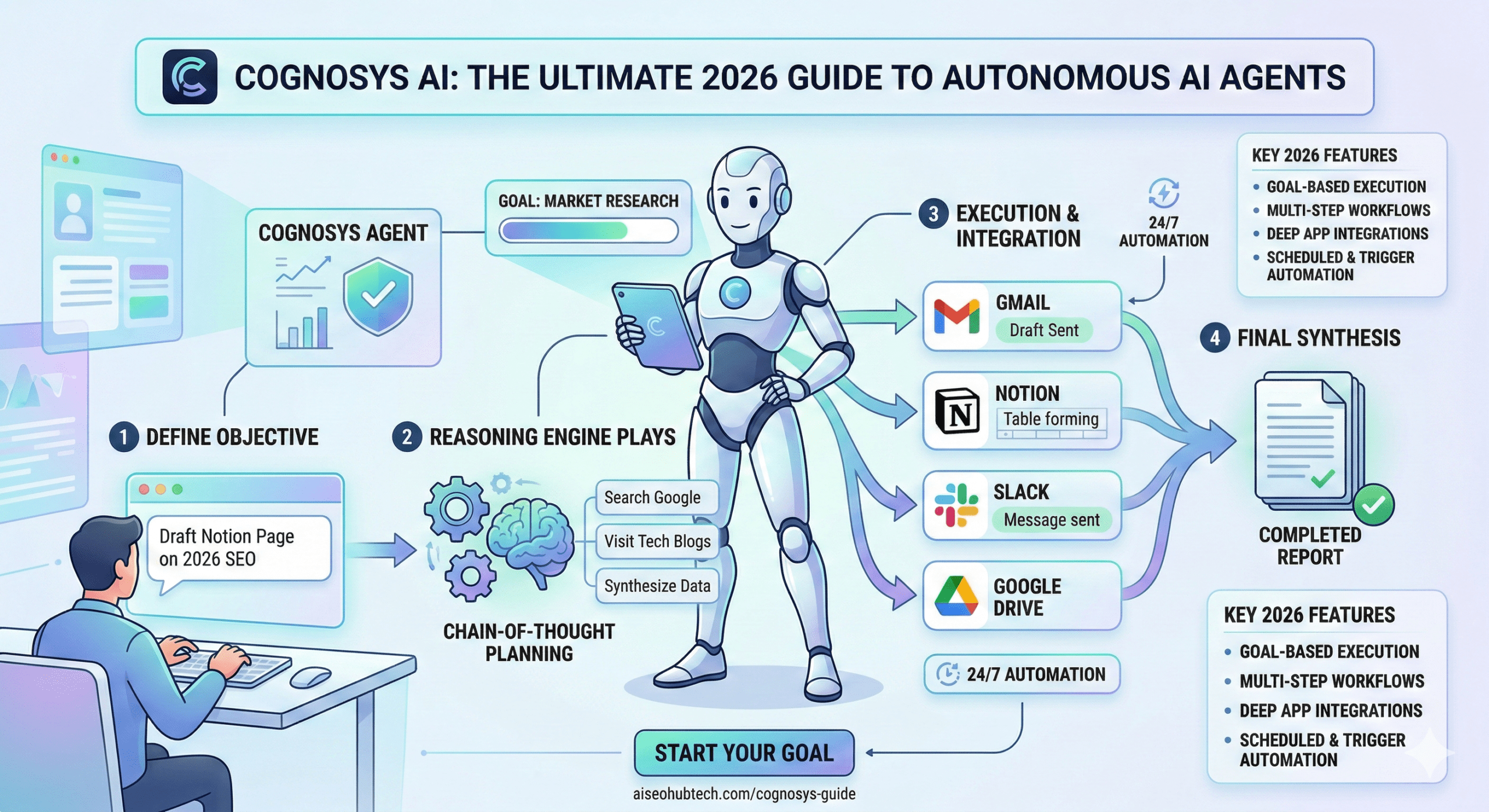
Cognosys AI works as an autonomous system that transitions from simple text generation to active goal execution. The process begins when the Reasoning Engine analyzes a user’s high-level objective and deconstructs it into a hierarchical sequence of sub-tasks. Unlike a standard chatbot, it uses a Task Orchestration System to manage these steps independently, coordinating between various tools and real-time internet data to fulfill the mission.
The engine operates in a continuous loop of perception and action, where it gathers context from integrated apps like Gmail, Notion, or Slack, evaluates the progress toward the goal, and dynamically adjusts its plan if it encounters obstacles. Once all individual tasks are completed, the Synthesis Engine compiles the findings into a structured, final output. This sophisticated orchestration ensures that complex, multi-step workflows—such as competitive market research or lead enrichment—are completed systematically without requiring constant human prompts at every stage.
Key Features of Cognosys AI
The primary strength of Cognosys AI lies in its autonomous execution and structured planning, which allows it to function as a self-sufficient digital workforce. Unlike traditional chatbots that require constant back-and-forth prompting, Cognosys handles complex, multi-step workflows by independently breaking down a single objective into a series of actionable tasks. This capability to automate repetitive processes—from deep market research to daily administrative duties—is driven by an advanced reasoning engine that plans, prioritizes, and executes each step systematically.
Furthermore, its extensive API integrations with essential workplace tools like Gmail, Notion, Slack, and Google Calendar create a unified productivity hub. This allows the AI agents to not only analyze data but also take real-time actions across different platforms, such as drafting emails or updating project trackers automatically. These features, combined with trigger-based scheduling and intelligent model selection, distinguish Cognosys AI from standard conversational tools, transforming it into a proactive partner for business automation.
Cognosys AI vs Other AI Agents
The fundamental difference between Cognosys AI and traditional AI chatbots lies in the shift from reactive conversation to proactive execution. While standard chatbots are designed to provide direct answers to specific user inputs, Cognosys AI utilizes goal-oriented planning to fulfill complex objectives. It doesn’t just respond; it thinks forward, creating a structured workflow of sub-tasks and executing them sequentially until the final mission is accomplished. This “agentic” behavior makes it significantly more powerful for automation and deep research compared to simple Q&A models.
When compared to other autonomous tools like AutoGPT or BabyAGI, Cognosys AI stands out due to its user-friendly web interface and stable task orchestration. While many AI agents require technical coding knowledge to deploy, Cognosys provides a polished, low-code environment with built-in API integrations for tools like Slack and Notion. This bridge between high-level reasoning and practical software integration allows it to handle real-world business tasks—such as automated lead generation or competitive intelligence—with a level of reliability that experimental agents often lack.
What Can You Build with Cognosys AI?
Cognosys AI allows you to move beyond simple prompts and build comprehensive automated research tools that can scan the live web, extract specific data points, and generate structured reports autonomously. By leveraging its reasoning engine, users can create sophisticated content planning systems that not only suggest topics but also perform competitive analysis and draft outlines across multiple platforms. This makes it an ideal engine for data analysis workflows, where the agent can ingest large datasets from integrated sources and identify trends or anomalies without manual oversight.
For those looking to scale operations, Cognosys AI is perfect for building business automation setups such as automated lead enrichment, customer support triaging, and personalized email outreach sequences. Developers can take this even further by using API integrations to connect Cognosys to their own software, creating customized AI solutions that act as “invisible employees” within their existing stack. These builds are highly effective for productivity and scaling, as they allow teams to delegate time-consuming, repetitive tasks to a persistent digital agent that works 24/7.
Is Cognosys AI Free or Paid?
Cognosys AI follows a freemium model, allowing users to explore autonomous agents for free while offering tiered subscriptions for power users and businesses. As of March 2026, the Free Plan typically includes around 100 messages per month and access to basic models like GPT-3.5, which is ideal for individual users testing simple research tasks. However, this tier has limitations on the number of concurrent agent connections and active workflows you can run at once.
For advanced users, the Pro Plan (starting at approximately $15 per month) unlocks the full potential of the platform, providing access to elite models like GPT-4 Turbo and Gemini Ultra. This tier increases usage limits to 1,000 messages, enables up to 10 active workflow automations, and allows for multiple document uploads per query. Larger organizations often opt for Ultimate or Enterprise plans, which offer unlimited messages, custom API integrations, and dedicated support to scale autonomous operations across an entire team.
How to Use Cognosys AI (Step-by-Step Guide)
Setting up an autonomous agent in Cognosys AI is a straightforward process that moves from a high-level goal to a fully executed result. Because the platform is web-based, you can deploy powerful AI workflows directly from your browser without needing technical coding skills.
Step 1: Account Creation & Initial Login
To get started, visit the official Cognosys.ai website. You can sign up using your Google or GitHub account for instant access. Once logged in, you will be greeted by a clean, minimal dashboard where you can manage your “Agents,” “Projects,” and “Tools.”
Step 2: Defining Your Goal (Objective Setting)
This is the most critical step. Instead of asking a simple question, you define a “Goal.” For example, instead of asking “What is SEO?”, you might set a goal like: “Research the top 5 SEO trends for 2026 and draft a 500-word summary in a Notion page.” A clearly defined goal helps the reasoning engine understand exactly what the final output should look like.
Step 3: Task Decomposition & Assignment
Once you submit your goal, Cognosys AI’s reasoning engine takes over. It automatically breaks your objective into several sub-tasks. You will see the AI agent systematically “assigning” these tasks to itself—such as searching Google, visiting specific tech blogs, and synthesizing information. You can watch this process in real-time as the agent checks off each task one by one.
Step 4: Reviewing & Adjusting the Output
After the agent completes all sub-tasks, it generates a final response or performs the requested action (like sending an email or saving a doc). At this stage, you should review the results for accuracy. If the output isn’t quite right, you can provide “Feedback” or “Adjustments”—for instance, asking the agent to “make the tone more professional” or “add more data on competitor pricing.”
Step 5: Deployment & Integration
If you are satisfied with the workflow, you can save the agent or integrate it with your existing apps. You can connect your Notion, Gmail, or Slack so that the agent can automatically move its finished work into your team’s workspace. For recurring needs, you can even schedule the agent to run automatically on a daily or weekly basis.
Benefits of Using Cognosys AI for Automation
Using Cognosys AI provides a transformative edge by shifting from simple task-handling to fully autonomous goal execution. This platform significantly reduces the manual burden on professionals by managing the entire lifecycle of a project—from initial research to final reporting—without requiring constant human intervention. By delegating repetitive, time-consuming tasks to AI agents, businesses can reallocate their human talent toward high-level strategic thinking and creative problem-solving.
The primary advantage is the massive increase in operational efficiency and time savings. In 2026, organizations using Cognosys AI-powered workflows report reducing manual effort by up to 80%, particularly in areas like finance, lead generation, and market analysis. By breaking complex objectives into manageable sub-tasks, the platform ensures that even the most intricate projects are executed with consistent precision and speed. This capability allows companies to scale their operations faster than ever before, maintaining a competitive advantage in a rapidly evolving digital market.
Is Cognosys AI Safe and Secure?
As with any enterprise-grade AI tool in 2026, security in Cognosys AI is built around the pillars of data encryption and controlled access. The platform utilizes industry-standard AES-256 encryption for data at rest and TLS 1.2 or higher for data in transit, ensuring that your goals, research data, and integrated credentials remain protected from unauthorized interception. For business users, Cognosys provides Role-Based Access Control (RBAC), which allows administrators to define exactly who can create, view, or execute specific autonomous workflows within an organization.
A critical aspect of Cognosys AI’s safety is its auditability and governance framework. Every action taken by an autonomous agent—whether it’s searching a specific website or updating a Notion database—is logged in a transparent audit trail. This ensures that the AI’s “Chain-of-Thought” is traceable, preventing “black box” operations and allowing humans to review decisions for accuracy and compliance. Additionally, Cognosys policies state that user data is generally not used to train the underlying foundation models (like GPT-4), preserving your intellectual property and data sovereignty.
Security Quick-Check for Users
| Feature | Security Standard |
| Data Encryption | AES-256 (At Rest) & TLS 1.3 (In Transit) |
| Compliance | Built to align with GDPR and SOC 2 frameworks |
| Governance | Full audit logs for every agent action |
| Integrations | Secure OAuth 2.0 authorization for third-party apps |
Cognosys AI Use Cases for Businesses
In 2026, Cognosys AI has evolved into a strategic partner for businesses, moving beyond simple automation to high-level decision intelligence. Startups and large enterprises alike use these autonomous agents to handle data-heavy workflows that previously required entire teams of analysts. By delegating the “heavy lifting” of data collection and synthesis to Cognosys, business leaders can focus on high-impact strategy and creative growth.
1. Automated Market & Competitor Intelligence
Businesses use Cognosys AI to conduct 24/7 competitive intelligence. Instead of manual browsing, an agent can be tasked to “monitor competitor pricing changes and product updates across 10 websites.” The agent autonomously scans for shifts in messaging, new feature launches, or pricing updates, and delivers a structured SWOT analysis or comparison report directly to the executive team. This real-time visibility allows companies to react to market shifts strategically rather than retroactively.
2. Sales Enablement & Lead Enrichment
For sales teams, Cognosys AI serves as a powerful lead qualification engine. Agents can autonomously crawl the web to find LinkedIn profiles, financial reports, or recent news for a list of potential B2B leads. It then synthesizes this unstructured data into a “Prospect Brief” in Notion or a CRM, allowing sales representatives to enter every meeting with deep, personalized insights. This eliminates hours of manual prospecting and significantly increases the success rate of outreach campaigns.
3. Content Strategy & Multi-Channel Planning
Marketing departments leverage Cognosys for end-to-end content orchestration. A single goal like “Develop a 30-day multi-platform content strategy for a new SaaS launch” triggers a multi-step workflow: the agent researches trending keywords, analyzes high-performing social posts in the niche, drafts content outlines, and even suggests optimal posting schedules. This allows lean marketing teams to maintain a massive digital footprint with minimal manual effort.
4. Operational & Finance Workflow Automation
At the enterprise level, Cognosys AI is used to streamline back-office operations. This includes automating invoice ingestion, where agents validate data against purchase orders and route them for approval, as well as HR onboarding workflows that manage employee record updates across multiple systems. By integrating with tools like Gmail, Slack, and Google Drive, Cognosys acts as a central orchestration hub that ensures business processes move smoothly without human bottlenecks.
Cognosys AI for Developers
For developers, Cognosys AI acts as a low-code agent builder and an orchestration layer that simplifies the deployment of autonomous systems. It allows engineers to design custom AI agents that can explain complex codebases, automate unit testing, and perform real-time debugging by tracing execution paths. By providing a structured framework for prompt engineering and memory management, Cognosys helps developers build agents that understand long-term project context rather than just processing isolated snippets of code.
Beyond simple coding assistance, advanced users leverage Cognosys AI to build smart backend automations through its robust API and third-party integrations. Developers can connect these agents to existing enterprise tools—such as GitHub, Jira, or custom databases—to automate CI/CD monitoring, ticket routing, and infrastructure scaling. This “agentic” approach allows developers to move away from rigid, script-based automation toward dynamic systems that can reason through exceptions, making it an essential platform for scaling AI-driven software operations in 2026.
Pros and Cons of Cognosys AI
Choosing Cognosys AI involves balancing its high-level automation capabilities with its learning curve and cost. In 2026, it remains a top choice for those moving from simple chatbots to autonomous digital workers.
Pros (Advantages)
- Autonomous Goal Execution: Unlike standard AI, you don’t need to guide it step-by-step. It plans, searches, and executes entire workflows based on a single high-level objective.
- Deep App Integration: It connects seamlessly with over 200+ popular workplace tools like Notion, Gmail, Slack, and Google Drive, allowing it to act as a central hub for your business data.
- Structured Research & Reporting: It excels at synthesizing vast amounts of internet data into clean, actionable reports, making it a “junior research assistant” that never sleeps.
- No-Code Friendly: Even with its advanced “Agentic” reasoning, the web interface is designed for non-technical users, making powerful AI automation accessible to everyone.
Cons (Disadvantages)
- Learning Curve for Complex Flows: While simple tasks are easy, setting up multi-step, trigger-based automations can be slightly complex for complete beginners to master.
- Limited Free Tier: The free version has restrictive usage limits (around 100 messages) and limited access to the most powerful models like GPT-4 Turbo or Gemini Ultra.
- Cost for Power Users: The $15/month starting price for Pro plans might be steep for hobbyists or students compared to standard chatbot subscriptions.
- Occasional “Looping” Issues: Like many autonomous agents, it can sometimes get stuck in a reasoning loop if a task is too vague or if a specific web source is blocked.
Quick Comparison: Is it Right for You?
| Feature | Best For | Potential Drawback |
| Individual Users | Daily research & email summaries | Free limit is quickly reached |
| Small Businesses | Automating lead gen & SEO research | Requires time to set up integrations |
| Developers | Building custom AI-backed workflows | Closed-source UI might feel limiting |
Real User Reviews of Cognosys AI
User feedback for Cognosys AI in 2026 highlights its role as a bridge between simple chatbots and complex developer tools. Most users view it as a “Junior Research Assistant” that excels at converting vague goals into structured results.
Here is a summary of real-world sentiment across major review platforms:
1. The Positive Feedback (The “Wins”)
- Logical Task Breakdown: Users consistently praise how Cognosys takes a “big, messy objective” and breaks it into a clear, logical task list. One verified user on G2 noted, “I like how it takes the bigger, complicated task and then breaks it into smaller ones… it helps me with repetitive tasks like email management and monthly research.”
- Autonomous Research: Many reviews highlight the platform’s “drive.” Unlike standard AI that stops after one answer, Cognosys is recognized for its persistence in searching the web until a goal is met.
- Web-Based Accessibility: For non-technical professionals, the polished web interface is a major pro. Users on Reddit have noted that it provides the power of tools like AutoGPT without requiring a terminal or complex Python setups.
2. The Mixed Reviews (The “Learning Curve”)
- Complex Workflows: While simple tasks are easy, some users find that setting up intricate, trigger-based workflows (like those involving multiple APIs) can be “tedious” and requires a bit of trial and error.
- “Looping” Issues: A common critique in technical circles (such as the r/AutoGPT community) is that the agent can sometimes get stuck in “hallucination loops”—repeating a flawed task if the initial search results are confusing or if a website blocks the agent.
- Support & Documentation: Some users have reported that while the tool is innovative, the customer support response times and deep technical documentation could be improved for enterprise-level troubleshooting.
3. Pricing Sentiment
- Free Plan Limitations: The most common “dislike” is the restrictive nature of the free tier. Users often feel that by the time they have properly configured a complex agent, they have already hit their message limit.
- High Value for Pros: Conversely, professional users who pay for the Pro or Ultimate plans generally feel the cost is justified by the hours saved on manual data synthesis and market monitoring.
Summary of User Ratings (2026)
| Platform | Average Rating | Primary User Base |
| G2 | 4.6 / 5 | Mid-Market & Business Admins |
| SourceForge | 5.0 / 5 | Early Adopters & Tech Enthusiasts |
| Product Hunt | 4.7 / 5 | Startup Founders & Prosumers |
Alternatives to Cognosys AI
In the rapidly evolving AI landscape of 2026, several platforms offer autonomous agent capabilities similar to Cognosys AI. While Cognosys is known for its polished web interface and task orchestration, these alternatives cater to different needs—ranging from open-source flexibility to enterprise-grade security.
1. AgentGPT
AgentGPT is the most direct competitor to Cognosys for browser-based automation. It allows you to deploy autonomous AI agents by simply giving them a name and a goal.
- Best For: Users who want a simple, visually appealing interface for one-off research tasks.
- Key Difference: While it is highly autonomous, it is often seen as slightly more experimental and less focused on deep business workflow integrations than Cognosys.
2. Lindy AI
Lindy AI focuses on creating “Digital Employees” rather than just task agents. It is designed to sit inside your professional stack and handle specific roles like an Executive Assistant, Recruiter, or SDR.
- Best For: Small business owners looking for ready-made AI personas that integrate deeply with calendars and CRMs.
- Key Difference: It offers a more “human-like” persona-based approach compared to the task-list style of Cognosys.
3. Relevance AI
Relevance AI is a high-powered alternative for businesses that need to build an entire “AI Workforce.” It excels at data enrichment, web scraping, and complex sales workflows.
- Best For: Sales and Marketing teams who need to process thousands of leads or data points autonomously.
- Key Difference: It is more “low-code” and data-centric, providing more granular control over how data is processed compared to Cognosys.
4. CrewAI (Open-Source)
For developers and technical teams, CrewAI is the leading framework for orchestrating “groups” of AI agents. It allows you to define different roles (e.g., a Researcher, a Writer, and a Reviewer) and have them work together.
- Best For: Developers who want to build custom, locally-hosted, or highly complex multi-agent systems.
- Key Difference: It requires Python coding knowledge but offers total flexibility and no subscription fees for the framework itself.
Quick Alternative Comparison (2026)
| Platform | Target Audience | Primary Strength | Starting Price |
| Cognosys AI | General Business Users | Structured task orchestration | Free / $15/mo |
| AgentGPT | Casual Users / Hobbyists | Ease of use (Zero setup) | Free / $40/mo |
| Lindy AI | SMBs & Solo-preneurs | Ready-to-use personas | Free / $39/mo |
| Relevance AI | Sales & Data Teams | Massive data enrichment | Free / Custom |
| CrewAI | Developers | Multi-agent collaboration | Open Source |
Final Verdict: Is Cognosys AI Worth It?
Whether Cognosys AI is worth the investment depends on your specific needs—specifically, whether you require a conversational assistant or an autonomous worker. In 2026, it stands out as a premier “agentic” platform that bridges the gap between simple AI chat and complex software automation.
FAQs Cognosys AI
1. How does Cognosys AI differ from ChatGPT?
While ChatGPT is a conversational AI that responds to individual prompts, Cognosys is an autonomous AI agent. ChatGPT requires you to lead it step-by-step; Cognosys takes a single high-level goal, breaks it into a task list, and executes those tasks independently until the goal is finished.
2. Is Cognosys AI free to use?
Yes, Cognosys offers a Free Plan that includes 100 messages per month, one active workflow, and one concurrent connection. For more advanced needs, the Pro Plan ($15/month) and Ultimate Plan ($59/month) offer significantly higher limits and access to superior models like GPT-4 Turbo and Gemini Ultra.
3. Which apps can I integrate with Cognosys?
Cognosys acts as a productivity hub, integrating with a wide range of popular 2026 tools, including:
- Google Workspace: Gmail, Google Drive, and Google Calendar.
- Productivity Tools: Notion, Slack, and Microsoft Outlook.
- Developer Tools: GitHub and various secure API connectors.
4. Can I schedule tasks to run automatically?
Yes. One of the platform’s strongest features is Scheduled & Trigger-Based Workflows. You can set an agent to run at a specific time (e.g., “Summarize the morning’s tech news at 8:00 AM”) or trigger it based on an event (e.g., “Research every new lead that signs up on my website”).
5. Is my data safe with Cognosys AI?
Cognosys uses AES-256 encryption and secure OAuth 2.0 protocols for all third-party app connections. In 2026, the platform adheres to strict privacy standards, ensuring that your personal or business data is used solely for executing your tasks and is generally not used to train global AI models.
6. Do I need to know how to code to use it?
No. Cognosys is a no-code platform with a user-friendly web interface. While it has an API for developers, regular users can build and deploy complex autonomous agents simply by typing their goals in plain English.
Quick Feature Summary
| Question | Answer |
| Best Use Case | Deep research and repetitive business workflows. |
| Model Access | GPT-3.5 (Free), GPT-4 Turbo & Gemini Ultra (Paid). |
| Platform Type | Web-based Autonomous Agent (No download required). |
| Automation Level | High (Fully autonomous “loops”). |