Introduction: The Rise of AI Chatbots
We are living in the age of artificial intelligence. Technology has fundamentally transformed the way people work, learn, communicate, and solve problems — and at the center of this transformation are AI chatbots. These tools are no longer confined to tech labs or enterprise boardrooms. They are now everyday companions for students, professionals, researchers, writers, and developers across the globe.
To put the scale in perspective: over 987 million people are actively using AI chatbots today. The global AI chatbot market is projected to reach $46.64 billion by 2029. These numbers are not just statistics — they represent a fundamental shift in how human beings interact with information and technology.
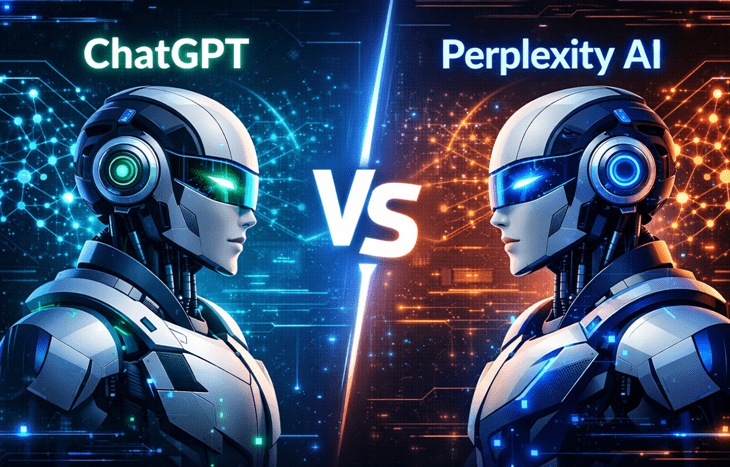
Among the dozens of AI chatbots now available, two stand out as the most widely used and frequently compared: ChatGPT, developed by OpenAI, and Perplexity AI, a newer entrant that has quickly gained a devoted following. Both tools appear similar on the surface — you type a question, you get an answer. But beneath that simple interface lie two very different philosophies, architectures, and strengths.
This guide goes deep. We will examine how each tool works under the hood, compare them across every major feature, walk through real-world test results, and help you understand which one deserves a place in your daily workflow — or whether you should be using both.
Whether you are a student doing research, a marketer crafting content, a developer debugging code, or simply a curious mind exploring AI — this guide will help you make an informed decision.
What Is ChatGPT?
ChatGPT is a conversational AI model developed by OpenAI, one of the world’s leading artificial intelligence research organizations. It is built on the GPT — Generative Pre-Trained Transformer — architecture, a type of large language model (LLM) that has been trained on an enormous corpus of text data including books, websites, academic papers, forums, news articles, and much more.
The result of this training is a system that can understand natural language with remarkable nuance, generate human-like responses, follow complex instructions, maintain context across a long conversation, and perform a wide variety of language-based tasks with impressive skill. ChatGPT does not just retrieve pre-written answers — it generates new text dynamically based on the context of your conversation.
Since its launch in late 2022, ChatGPT has become the fastest-growing consumer application in history, reaching 100 million users in just two months. It has since been updated multiple times, with GPT-4o representing the current flagship model that combines text, image, and voice capabilities in a single unified interface.
Core Capabilities of ChatGPT
- Natural conversation: Engages in multi-turn dialogue while retaining context throughout the session
- Creative writing: Produces stories, essays, poems, scripts, marketing copy, and more
- Code generation and debugging: Writes, reviews, and fixes code in virtually every programming language
- Image analysis: Understands and describes photos, diagrams, charts, and documents
- Data interpretation: Analyzes datasets, creates visualizations, and explains trends
- Math and logic: Solves complex problems step by step
- Multilingual support: Communicates fluently in over 100 languages
- Document summarization: Reads and condenses long documents into key insights
- Brainstorming and ideation: Helps generate ideas, explore concepts, and think through problems
How ChatGPT Works
At its core, ChatGPT is a large language model trained on a fixed dataset with a specific knowledge cutoff date. When you ask it a question, it draws on its internal training to generate a response — it does not automatically search the internet for every query. This means its knowledge can be outdated for recent events unless web search mode is explicitly enabled.
However, ChatGPT’s strength lies in its ability to reason, synthesize, and create. It does not just regurgitate information — it understands relationships between ideas, applies logic, follows nuanced instructions, and generates genuinely novel content. This makes it exceptional for tasks that require thinking and creativity, not just information lookup.
The conversational memory within a session is one of ChatGPT’s most powerful features. You can start a conversation, take it in a completely different direction, come back to an earlier topic, and ChatGPT will maintain coherent context throughout — making it feel less like a search engine and more like a knowledgeable colleague.
What Is Perplexity AI?
Perplexity AI is a fundamentally different kind of tool. Founded in 2022 by former researchers from OpenAI and Meta, it was designed from the ground up to address one of the biggest limitations of traditional language models: the inability to access real-time, current information from the web.
The simplest way to understand Perplexity AI is this: imagine combining the breadth of Google Search with the conversational intelligence of an AI language model. When you ask Perplexity a question, it does not rely solely on pre-trained knowledge. Instead, it performs a live web search — pulling information from Google, Bing, academic databases, WolframAlpha, Reddit, and other sources — and then uses a language model to synthesize that information into a clear, concise, cited answer.
This approach makes Perplexity fundamentally more reliable for current events, recent research, and factual queries where accuracy and source verification matter. Rather than receiving a confident-sounding answer that might be outdated or hallucinated, you receive an answer that is grounded in real, verifiable sources you can click through and read yourself.
Core Capabilities of Perplexity AI
- Real-time web search: Queries the live web for every response, ensuring current information
- Automatic citations: Every answer includes numbered source links for verification
- Academic search: Filters specifically for peer-reviewed papers and published research
- WolframAlpha integration: Handles computational, mathematical, and scientific queries
- Focus filters: Narrows search to specific source categories (Academic, Social, All, etc.)
- Deep Research mode: Cross-references multiple sources for comprehensive reports
- Image and visual results: Provides relevant images alongside text answers
- Follow-up awareness: Maintains context within a conversation thread
- Related questions: Suggests follow-up queries to deepen understanding
How Perplexity AI Works
Perplexity AI uses a technique called Retrieval-Augmented Generation (RAG). Rather than relying purely on pre-trained knowledge, it first retrieves relevant content from the web in real time, and then passes that content to a language model to generate a synthesized, readable response. The language model acts as an intelligent summarizer and organizer, not just a retriever.
This architecture has a significant advantage: the information is always current, and the sources are always visible. There is no training cutoff problem because the model is always pulling fresh data. The downside is that Perplexity is fundamentally dependent on what exists on the web — if you need something that requires imagination, original thinking, or content creation that goes beyond information synthesis, it is less suited to the task.
AI-Related Post
Head-to-Head: Real-World Test Results
Theory only takes you so far. To give you a concrete sense of how these two tools perform in practice, we tested both across three distinct categories: a factual scientific question, a mathematical reasoning problem, and an open-ended creative planning request. Here is what we found.
Test 1: Scientific Question — What Causes Tsunamis?
We asked both tools the same question: What causes a tsunami in the sea?
ChatGPT Response:
ChatGPT provided a well-organized, clearly written answer. It explained the primary causes — including seismic activity on the ocean floor, submarine volcanic eruptions, and underwater landslides — in a logical sequence with good use of paragraph breaks. The response was thorough, readable, and accurate. However, it presented the information as a standalone block of text without visual support or source links.
Perplexity AI Response:
Perplexity provided a similarly accurate and well-structured answer, but enriched it with several additional elements: source citations from reputable sites like NOAA and Wikipedia, relevant images of tsunamis and seismic maps, and a section of related questions to explore further. The overall experience felt more like a researched encyclopedia entry than a standalone AI response.
Verdict:
Winner: Perplexity AI — While ChatGPT’s prose was clean and accurate, Perplexity’s addition of cited sources, images, and related questions created a richer, more trustworthy informational experience. For factual research, this matters.
Test 2: Mathematical Reasoning — Undefined Value Problem
We presented both tools with a deliberately tricky equation: x = y = 1/(y-1). If y = 1, what is the value of x?
ChatGPT Response:
ChatGPT correctly identified that substituting y = 1 into the denominator produces 1/0, which is mathematically undefined. The answer was correct and concise — but it arrived at the conclusion in essentially one step, without explaining the reasoning process in accessible terms for a non-mathematician.
Perplexity AI Response:
Perplexity also arrived at the correct answer, but the path was notably different. It first set up the substitution clearly, then explained why dividing by zero is undefined in mathematics, then addressed what this means for the value of x, and finally delivered the conclusion. The step-by-step structure made the reasoning accessible to anyone, regardless of their math background.
Verdict:
Winner: Perplexity AI — Correct answers matter, but so does comprehension. Perplexity’s structured, explanatory approach is far more educational and useful for anyone who wants to understand the reasoning, not just receive the result.
Test 3: Open-Ended Creative Task — Paris 10-Day Itinerary
We asked both tools: Create a 10-day itinerary for a trip to Paris.
ChatGPT Response:
ChatGPT generated a day-by-day itinerary covering the major landmarks: Eiffel Tower, Louvre, Versailles, Montmartre, Musee d’Orsay, and so on. The structure was clear and the suggestions were reasonable. However, it did not include hotel recommendations, ticket pricing, budget tips, transportation advice, or local insider knowledge that would make the itinerary genuinely useful for planning.
Perplexity AI Response:
Perplexity produced a nearly identical structure — the same major landmarks, the same basic day-by-day format, and similarly absent practical details. This was a clear case where both tools defaulted to generic output rather than a truly helpful, personalized plan.
Verdict:
Result: Tie — Both tools produced basic, functional itineraries but fell short of the depth a real traveler would need. For this type of creative, personalized planning task, more specific prompts — including preferences, budget, travel style, and interests — are essential to unlock better results from either tool.
Test Results Summary
| Test Scenario | ChatGPT | Perplexity AI | Winner |
| Scientific Question | Clear, well-structured answer | Cited sources + images + related Qs | Perplexity AI |
| Math Problem | Correct but brief | Step-by-step with reasoning | Perplexity AI |
| Creative Itinerary | Basic day-by-day plan | Basic day-by-day plan | Tie |
Deep Dive: Feature-by-Feature Comparison
1. Conversation Style and User Experience
ChatGPT was designed from the beginning as a conversational AI. Its strength lies in the naturalness of dialogue — the way it picks up on subtle cues in your phrasing, adapts its tone to match yours, and maintains a consistent thread of context throughout a session. You can have an exploratory, free-flowing conversation with ChatGPT in a way that feels genuinely engaging. It remembers what you said three messages ago. It understands when you change direction. It can joke, be formal, be encouraging, or be technical — based entirely on how you communicate with it.
Perplexity AI, by contrast, is conversational in structure but research-oriented in spirit. It will answer follow-up questions and maintain thread context, but it does not feel like a dialogue partner. It feels more like a highly capable research assistant who gives you the most accurate possible answer and then waits for your next query. This is not a criticism — it is a design choice that reflects Perplexity’s core purpose.
2. Web Research and Information Retrieval
This is arguably the most important difference between the two tools, and it is where Perplexity AI holds a clear structural advantage.
Perplexity AI performs a live web search for every query by default. It draws from multiple source types simultaneously — general web results, academic publications, computational databases, and social platforms — and synthesizes the findings into a single coherent response. Every claim is backed by a numbered citation you can click to verify. This means you are never just trusting the AI; you can always trace the information back to its origin.
ChatGPT supports web search, but it is not the default behavior. Standard ChatGPT responses draw on the model’s internal training data, which has a fixed knowledge cutoff. Web search must be explicitly enabled, and even when it is active, citations are not always provided. For queries where accuracy and currency matter — recent news, current statistics, evolving research — Perplexity is the more reliable choice by design.
3. Creative Content Generation
In creative tasks, ChatGPT has no peer among general-purpose AI tools. Its architecture, training, and design are optimized for generative tasks — producing original content that did not exist before the prompt was entered.
- Long-form storytelling and fiction writing
- Poetry, song lyrics, and creative prose
- Marketing copy, ad scripts, and brand messaging
- Email drafting — formal, persuasive, casual, or empathetic
- Social media content and caption writing
- Code generation, debugging, and explanation
- Educational content, lesson plans, and quizzes
- Roleplay, character creation, and dialogue writing
Perplexity AI can generate content, but creative generation is not its strength. Its underlying design prioritizes information synthesis over imaginative output. When asked to write a short story or a creative essay, it will produce something functional — but it lacks the flair, originality, and tonal versatility that ChatGPT brings to creative tasks.
4. Accuracy and Hallucination Risk
One of the most commonly discussed challenges with large language models is hallucination — the tendency to generate plausible-sounding but factually incorrect information with unwarranted confidence. Both tools address this challenge, but in different ways.
Perplexity AI has a structural advantage here. Because every response is grounded in live web content retrieved at the moment of the query, the risk of fabricating information is significantly lower. The model is synthesizing and organizing real content rather than generating facts from internal parameters. And because sources are always cited, users have a built-in verification mechanism.
ChatGPT has made substantial progress in reducing hallucinations across successive model generations, but the risk is not eliminated — particularly for queries that fall outside the training data or that involve specific numerical facts, citations, or recent events. The practical guidance: use ChatGPT for creative, analytical, and conversational tasks; use Perplexity for queries where factual accuracy and source verification are critical.
5. Language Support
ChatGPT supports over 100 languages and handles multilingual communication with impressive fluency. You can write to it in one language and ask it to respond in another. It can translate, explain idioms, write formal documents, and even code-switch mid-conversation. For global users or multilingual projects, ChatGPT is the clear choice.
Perplexity AI currently supports 28 languages. While this covers the major world languages, it is a meaningful limitation for users whose primary language is not among them — particularly for professional or academic work that requires precision in a specific language.
6. Pricing and Plans
ChatGPT Pricing:
- Free: Full access to GPT-4o mini, limited access to GPT-4o and o3-mini, basic web search via Bing, limited file upload and analysis
- Plus ($20/month): Full GPT-4o access, o3-mini and o3-mini-high, limited Deep Research access, limited Sora video generation
- Pro ($200/month): Unlimited access to all o-series models, advanced voice mode, o1 Pro mode, maximum Deep Research and Sora access
Perplexity AI Pricing:
- Free: Unlimited quick searches with basic AI models, 3 Pro searches per day (with access to more powerful models)
- Pro ($20/month): 300+ Pro searches per day, access to advanced AI models (GPT-4o, Claude, Gemini), Deep Research, file uploads and analysis
From a value perspective, Perplexity’s free plan is exceptionally generous — unlimited quick searches at no cost is a compelling offer. ChatGPT’s free plan is also capable, but power users will encounter limitations more quickly. At the $20/month tier, both tools offer strong value, though they serve different primary use cases.
Special Modes: Deep Research and Focus Filters
ChatGPT: Deep Research Mode
Deep Research is ChatGPT’s most powerful mode for complex informational tasks, available to Plus and Pro subscribers. When activated, it transforms ChatGPT from a conversational assistant into an autonomous research agent that:
- Browses multiple web sources over an extended session
- Analyzes, cross-references, and synthesizes information from diverse inputs
- Produces a structured, comprehensive report with citations and organized sections
- Identifies gaps, contradictions, and nuances across sources
Deep Research mode is designed for tasks that would otherwise require hours of manual research: competitive market analysis, academic literature reviews, technical deep dives, due diligence reports, and comprehensive topic overviews. It is not suited for quick factual lookups — but for genuinely complex research tasks, it produces report-quality output that can save significant time.
ChatGPT: Standard Search Mode
With web browsing enabled, ChatGPT can also function as a search assistant for more routine queries. This mode allows it to access current information — recent news, updated statistics, newly published content — that falls outside its training data. Unlike Perplexity, however, it does not automatically search for every query, and citations are not always provided unless explicitly requested. Users should verify time-sensitive information independently when using this mode.
Perplexity AI: Deep Research Mode
Perplexity’s Deep Research mode is available to all users (with limited daily queries on the free plan and full access on Pro). It is purpose-built for complex, multi-source research tasks where accuracy and comprehensiveness are paramount. In this mode, Perplexity:
- Simultaneously queries dozens of web sources on the topic
- Cross-references findings across sources to identify consensus and discrepancies
- Structures results into a readable, organized report
- Cites every source clearly, enabling independent verification
For academic research, professional reports, scientific inquiries, and any task where data integrity matters, Perplexity’s Deep Research mode is exceptional. It essentially performs the work of a thorough research assistant in minutes, with the added credibility of full source transparency.
Perplexity AI: Focus Filter Mode
Focus Filters are a unique and powerful Perplexity feature with no direct equivalent in ChatGPT. They allow users to specify which category of sources the AI should search, dramatically increasing the relevance and reliability of results for specific use cases:
- All: Standard web search across all indexed content
- Academic: Restricted to peer-reviewed papers, journals, and scholarly publications — ideal for research and citations
- WolframAlpha: Pulls only from Wolfram’s computational knowledge engine — best for math, science, and data
- Social: Searches Reddit, forums, and social media — useful for understanding public opinion, community sentiment, or real-world user experiences
For a researcher who needs only peer-reviewed sources, a data analyst who needs computational answers, or a marketer who wants to understand what real people are saying online, these filters are not just convenient — they are genuinely transformative for research efficiency.
Complete Feature Comparison at a Glance
| Feature | ChatGPT | Perplexity AI |
| Primary Use | Conversation, Creative Writing, Coding | Research, Fact-Finding, Citations |
| Web Search | Bing (optional, limited) | Google, Bing, WolframAlpha, Academic DBs |
| Automatic Citations | No (must request) | Yes, with every answer |
| Language Support | 100+ languages | 28 languages only |
| Creative Content | Excellent | Limited |
| Deep Research Mode | Plus & Pro users only | Free (limited), Pro (full) |
| Context Retention | Excellent across turns | Good within same thread |
| Image Analysis | Yes (GPT-4o) | Limited |
| Focus Filters | Not available | Academic, WolframAlpha, Social, All |
| Hallucination Risk | Moderate | Lower (web-grounded) |
| Free Plan | GPT-4o mini, 3 searches/day | Unlimited quick searches, 3 Pro/day |
| Paid Plan | $20/mo (Plus), $200/mo (Pro) | $20/mo (Pro) |
Which Tool Should You Use? A Practical Guide
Choose ChatGPT If You Need…
- A conversational AI companion for extended, flowing dialogue on any topic
- Creative writing — fiction, poetry, scripts, blogs, marketing copy, and more
- Code writing, debugging, explaining, or refactoring in any programming language
- Image analysis and interpretation — upload a photo, chart, or document and get insights
- Brainstorming sessions where ideas need to be explored, expanded, and developed
- Multilingual communication, translation, or language learning support
- Drafting professional documents: emails, reports, proposals, cover letters
- Step-by-step reasoning through complex problems — mathematical, logical, or conceptual
- Working with uploaded files: spreadsheets, PDFs, data files
Choose Perplexity AI If You Need…
- The latest, most up-to-date information on any topic — news, research, statistics
- Cited, verifiable answers where you can trace every claim back to its source
- Academic research drawing on published, peer-reviewed papers and journals
- Fact-checking claims or verifying information before using it professionally
- Competitive analysis, market research, or industry trend monitoring
- Computational or mathematical answers powered by WolframAlpha
- Medical, legal, or scientific information where source credibility is critical
- Understanding public opinion or community sentiment through social media filters
- Quick, reliable answers to factual questions without lengthy prose
Use Both Tools Together For…
The most productive AI workflow often involves using both tools in complementary ways:
- Use Perplexity to research and gather cited, current facts on a topic
- Use ChatGPT to transform that research into polished, well-written content
- Use Perplexity to fact-check claims generated by ChatGPT
- Use ChatGPT to brainstorm and ideate, then Perplexity to validate and source
Treating these tools as mutually exclusive is a missed opportunity. They are more powerful together than either is alone.
Honest Assessment: Limitations of Each Tool
ChatGPT’s Limitations
- Knowledge cutoff: Without web search enabled, it cannot access information published after its training data was collected
- Hallucination risk: Can generate confident-sounding but incorrect information, especially for specific facts, citations, or obscure topics
- No automatic citations: Does not proactively cite sources unless the user requests it
- Search is not the default: Web browsing must be explicitly enabled, unlike Perplexity’s always-on approach
- Cost at higher tiers: The Pro plan at $200/month is expensive for individual users
- Inconsistency: Response quality can vary based on how well the prompt is written
Perplexity AI’s Limitations
- Language support: Only 28 languages, compared to ChatGPT’s 100+
- Creative weakness: Not designed for imaginative, generative, or creative tasks
- Conversational depth: Does not match ChatGPT’s ability to sustain a rich, evolving dialogue
- Web dependency: If a topic is not well-represented online, answers may be incomplete or shallow
- Limited Pro searches on free plan: Only 3 deep searches per day without a paid subscription
- No image generation or voice mode: These features are currently absent
Conclusion: The Final Verdict
After a thorough comparison across technology, features, real-world tests, pricing, and use cases, the conclusion is clear — but perhaps not the one you expected. There is no single winner. ChatGPT and Perplexity AI are not competing for the same role. They are optimized for fundamentally different tasks, and the right tool depends entirely on what you are trying to accomplish.
ChatGPT is the best general-purpose AI assistant available today. It excels at conversation, creative work, coding, reasoning, and any task that requires the machine to think, generate, and create. Its ability to maintain context, adapt tone, and produce genuinely original content makes it an invaluable tool for writers, developers, educators, and anyone who needs a capable thinking partner.
Perplexity AI is the best AI-powered research tool available today. It excels at finding, synthesizing, and citing current, accurate information from the web. Its real-time search architecture, automatic citations, and focus filters make it the go-to choice for researchers, students, professionals, journalists, and anyone who needs reliable, verifiable information quickly.
If you must choose only one: choose based on your most frequent use case. If you write, create, code, or converse — start with ChatGPT. If you research, verify, and need current information — start with Perplexity AI. But the ideal approach is to use both strategically, letting each tool do what it does best.
The best AI strategy is not about picking the right tool — it is about knowing when to use which tool. Master both, and you will be equipped to handle almost any intellectual or creative challenge that comes your way.
FAQs – ChatGPT vs Perplexity AI
1. What is the main difference between ChatGPT and Perplexity AI?
The main difference is how they retrieve information. ChatGPT focuses on conversational AI and content generation, while Perplexity AI works more like an AI-powered search engine that provides answers with cited sources from the web.
2. Which AI tool is better for research: ChatGPT or Perplexity AI?
For quick research and finding sources, Perplexity AI is often better because it shows references from websites. However, ChatGPT is stronger for detailed explanations, writing tasks, and complex problem-solving.
3. Is ChatGPT more powerful than Perplexity AI?
In many cases, yes. ChatGPT, developed by OpenAI, is generally more powerful for creative writing, coding, and advanced conversations. Perplexity AI focuses more on real-time web search and summarized answers.
4. Can Perplexity AI replace traditional search engines?
Perplexity AI can sometimes replace traditional search engines like Google for quick answers because it summarizes information from multiple sources. However, for broader searches and browsing different websites, search engines are still widely used.
5. Which AI tool is better for content writing?
ChatGPT is usually better for content writing because it can generate blog posts, articles, scripts, and marketing copy with better structure and creativity.
6. Does Perplexity AI provide more accurate answers?
Perplexity AI often provides cited sources, which helps users verify information. ChatGPT may provide deeper explanations but sometimes requires fact-checking depending on the topic.
7. Are ChatGPT and Perplexity AI free to use?
Both tools offer free versions. However, they also provide premium plans with advanced features such as faster responses, better AI models, and enhanced capabilities.
8. Which AI tool is better for students?
Students may prefer Perplexity AI for quick research with sources, while ChatGPT is more helpful for explaining concepts, summarizing notes, and assisting with assignments.
9. Can ChatGPT access real-time internet data like Perplexity AI?
Perplexity AI is specifically designed to pull information from live web sources. ChatGPT can also access updated information depending on the model and tools being used.
10. Should I use ChatGPT or Perplexity AI in 2026?
The best choice depends on your needs. If you want powerful AI writing and conversation capabilities, ChatGPT is ideal. If you prefer AI-powered search with source citations, Perplexity AI is a good option.