
Focus Writing articles with AI: How Smart Tools Help You Create SEO-Perfect Articles in Minutes
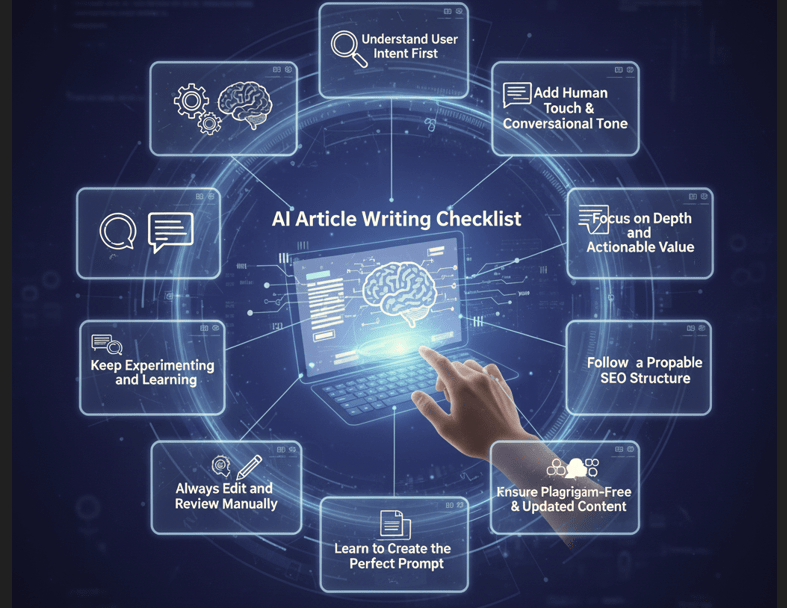
As you may have already learned a lot about AI and SEO from our previous articles, this description focuses on one of the most important aspects — what to keep in mind when writing or generating an article with AI so that your content becomes valuable for both users and Google.
The first and most crucial point is to clearly define user intent — don’t just give AI a keyword, but explain what the reader is actually looking for, what problem they want solved, and what tone should be used. This helps AI generate content that’s relevant and contextually accurate.
Second, always add a human touch. Include storytelling, real-life examples, and an empathetic tone that connects emotionally with the reader. Third, focus on depth and actionable value — go beyond general information by including case studies, step-by-step guidance, checklists, and updated data so the article provides real, useful insights.
Next, ensure a proper on-page SEO structure: use relevant H2/H3 headings, naturally place target keywords, include meta tags, and add a helpful FAQ section so the content is both user-friendly and optimized for ranking.
It’s also essential to check for plagiarism and factual accuracy, as AI may reuse outdated or incorrect data. Always verify sources and update facts to maintain credibility. Finally, manual editing gives your article the human flow and emotional depth AI alone can’t provide.
End your article with a clear call to action (CTA) and personalized tone that encourages readers to take the next step.
By following these principles, you can combine the speed of AI with the creativity and intelligence of a human writer, creating articles that not only rank better in search results but also genuinely help and engage readers.
Understand User Intent First
Understanding user intent is the foundation of creating high-quality, SEO-friendly content. In today’s AI-driven content landscape, it’s not enough to simply provide a keyword and let AI generate text. The real difference lies in how well you define why a user is searching for something and what they truly expect to find. User intent determines the direction, tone, and depth of the article — and this clarity helps AI craft content that feels relevant, personalized, and genuinely useful.
Before asking AI to write, take a moment to think from the reader’s perspective. Every search query has a goal behind it: some users want quick information, others seek detailed tutorials, comparisons, or real solutions to their problems. For instance, a person searching for “AI SEO” could be curious about what it means, while another searching “how AI tools improve SEO rankings” is clearly looking for a practical, step-by-step guide. Recognizing this difference allows you to tailor your content precisely to the reader’s needs.
When you clearly define user intent in your AI prompt, the quality of output improves dramatically. Instead of generic paragraphs, AI delivers focused explanations that match the reader’s expectations. For example, rather than simply instructing AI to “write an article on AI SEO,” a more detailed request like “create a beginner-friendly guide explaining how AI tools enhance SEO performance with examples” gives the AI proper direction. The result is content that not only informs but also educates and engages.
Ultimately, understanding user intent transforms AI writing from mere text generation into meaningful communication. It bridges the gap between algorithms and human needs, ensuring your content ranks higher on search engines while resonating deeply with real readers — the perfect balance of SEO strategy and authentic connection.
Add Human Touch & Conversational Tone
Adding a human touch and conversational tone is one of the most important aspects of creating engaging and SEO-friendly content with AI. While artificial intelligence can generate text quickly, it often lacks emotion, warmth, and personality — qualities that make readers feel connected to what they’re reading. Google’s algorithms have evolved to prioritize content that feels natural, relatable, and genuinely written for humans rather than machines. This means your AI-generated articles must sound like they’re coming from a real person who understands the reader’s feelings, problems, and motivations.
A conversational tone makes your writing more approachable and enjoyable. It’s the difference between reading a lecture and having a friendly conversation with someone who truly gets you. By adding real-world examples, storytelling, and emotional expressions, your content becomes more alive and authentic. Phrases like “Imagine you’re searching for something…” or “You’ve probably noticed that…” instantly create a bond between the reader and the writer. This not only keeps the reader engaged but also encourages them to stay longer on your page — a factor that improves SEO performance.
When instructing AI, guide it to write as if it’s speaking directly to one person, not a crowd. The goal is to make the reader feel seen and understood. Use simple, clear language and a tone that feels friendly yet informative. Avoid overcomplicating sentences or stuffing keywords unnaturally. Instead, let your content flow naturally, with emotion and intent behind every sentence.
Ultimately, adding a human touch transforms ordinary AI-generated text into meaningful communication. It builds trust, increases readability, and gives your content personality — something algorithms alone can’t achieve. In today’s world of automated writing, the content that truly stands out is the one that feels human, sincere, and emotionally engaging.
Focus on Depth and Actionable Value
When creating AI-generated content, focusing on depth and actionable value is what truly separates average articles from high-performing ones. Many AI tools can produce text quickly, but most of that content tends to be surface-level — filled with generic statements that neither educate nor inspire the reader to take action. Google’s ranking systems have become smarter, prioritizing content that shows real expertise, practical insight, and usefulness. That’s why your goal should always be to make the content rich in detail, backed by facts, and full of real-world applicability.
Depth means going beyond definitions and summaries. Instead of just explaining what something is, dive into why it matters and how it works. Readers visit your page looking for answers, not just information — they want guidance that helps them solve a specific problem. This is where actionable value comes in. Every section should give the reader something they can immediately apply — whether it’s a new strategy, a helpful tip, or a framework to follow.
Adding recent data, case studies, or practical examples makes the content trustworthy and authoritative. For instance, including up-to-date statistics from 2024–2025 or a real brand case study helps demonstrate credibility. Likewise, using simple step-by-step breakdowns or visual elements like pros and cons tables makes the content easier to understand and implement.
This approach directly supports Google’s E-E-A-T framework — Experience, Expertise, Authoritativeness, and Trustworthiness — which defines what high-quality content looks like. When AI-generated articles reflect real knowledge and depth, they resonate better with readers and rank higher on search engines. In short, don’t just aim for words — aim for wisdom. Give your audience insights that educate, inspire, and empower them to take meaningful action after reading.
Follow a Proper SEO Structure
When generating articles using AI, one of the most overlooked yet essential aspects is maintaining a proper SEO structure. A well-structured article doesn’t just help search engines understand your content better — it also makes it easier for readers to navigate, engage, and stay longer on your page. Many writers focus only on inserting keywords, but true SEO optimization goes far beyond that. It’s about organizing your content logically, ensuring that each section flows smoothly into the next, and strategically placing elements that signal value to both Google and the audience.
The article’s introduction should immediately include the primary keyword within the first 100 words to establish context and relevance. This tells search engines what the content is about right from the beginning. Subheadings — especially H2 and H3 tags — should then divide the content into meaningful sections. These not only enhance readability but also help Google’s crawlers identify key topics and hierarchy within your article. Each subheading should focus on a unique aspect of the topic, keeping the flow natural and informative.
Additionally, internal and external linking play a vital role in SEO structure. Internal links guide readers to related pages on your site, improving user experience and site authority, while external links to credible sources show Google that your content is trustworthy and well-researched.
Equally important are SEO-friendly meta titles and descriptions that attract clicks from search results. These should include the main keyword but read naturally, offering clear value to the user. A FAQ section, inspired by Google’s “People Also Ask,” can also increase your chances of appearing in featured snippets, further boosting visibility.
In short, an effective SEO structure helps your content perform better in every way — higher rankings, stronger engagement, and greater credibility in the eyes of both readers and search engines.
Keep It Readable and Well-Formatted
When it comes to AI-generated content, readability and formatting are just as important as the information itself. Even the most valuable article can fail to perform if it looks cluttered or difficult to read. Readers today have short attention spans, and they tend to skim rather than read every word. That’s why your AI-generated articles should always be formatted in a clean, visually engaging, and easy-to-digest manner. Proper formatting not only improves the reader’s experience but also sends positive engagement signals to Google, which helps improve SEO performance.
To keep the content readable, ensure that paragraphs are short and well-balanced — ideally no longer than two or three lines each. This breaks down the text into bite-sized sections that are easier on the eyes, especially on mobile screens. The tone should be friendly and conversational, helping readers feel like they’re having a one-on-one discussion rather than reading a dry, technical piece. Complex topics should be simplified through clear explanations and real-world examples that anyone can understand, regardless of their expertise.
Visual cues such as bullet points, emojis, or short highlights can make key insights stand out instantly. For example, using an emoji like 💡 or ✅ next to an important takeaway adds a touch of personality and helps readers quickly grasp essential points while skimming.
Another crucial aspect is using enough white space, proper subheadings, and short sentences to maintain flow and balance throughout the article. Readers should feel comfortable scrolling through the page without feeling overwhelmed.
In essence, well-formatted, easy-to-read content keeps users engaged for longer, lowers bounce rates, and increases dwell time — all of which are strong SEO signals. When readability meets valuable information, your AI-generated articles can truly connect with both readers and search engines.
Ensure Plagiarism-Free & Updated Content
When using AI to create articles, one of the biggest challenges is ensuring that the content remains original, updated, and trustworthy. While AI tools can generate impressive text within seconds, they sometimes rephrase existing information or include outdated data that can harm your site’s credibility. To make your content valuable for both readers and search engines, it’s essential to review, refine, and verify every piece of AI-generated text before publishing.
Plagiarism-free content is non-negotiable. Even slight duplication can trigger penalties from Google and damage your site’s reputation. Always check your AI-written article using reliable plagiarism detection tools like Grammarly, Quetext, or Copyscape. These tools help identify sentences or phrases that might resemble existing web content so you can rewrite or replace them. Originality reflects professionalism and builds trust with your audience, ensuring that your website stands out from the competition.
Equally important is keeping your information up-to-date. The digital landscape changes rapidly — SEO algorithms, ranking factors, and user behaviors evolve almost monthly. Therefore, always verify that your article reflects 2024–2025 data, trends, and insights. Whether you’re mentioning keyword strategies, AI advancements, or Google algorithm updates, ensure that all examples and references are current and relevant. This freshness not only appeals to readers but also boosts your ranking potential, as Google favors recently updated, authoritative content.
Moreover, AI-generated content must align with modern Google SEO trends, such as E-E-A-T (Experience, Expertise, Authoritativeness, Trustworthiness) and user-first writing. The more accurate and current your content, the more likely it is to rank and engage effectively.
In short, before hitting publish, always verify originality and freshness. Clean, plagiarism-free, and up-to-date content signals both credibility and quality, helping your AI-generated articles perform better and build lasting authority online.
Add Personalization & a Strong Call-to-Action (CTA)
When crafting AI-generated content, personalization and a powerful Call-to-Action (CTA) are what transform an ordinary article into an engaging and result-driven experience. No matter how informative your content is, if it doesn’t guide the reader toward a next step, it risks losing impact. A well-written article should always inspire the audience to take action — whether that’s learning more, subscribing, purchasing, or simply reflecting on what they’ve read.
Personalization is the first key. Instead of writing in a distant, robotic voice, make the reader feel directly spoken to. Use language like “you,” “your business,” or “your goals” to create an emotional connection. When the reader feels seen and understood, they’re far more likely to trust your message and take the next step. AI tools can easily mimic a human tone, but they must be guided to maintain warmth, empathy, and relatability throughout the content. Personal touches like relatable examples, motivating lines, or tailored advice make the article feel alive and authentic.
The second key element is a strong CTA — a line that motivates readers to act right away. This could be an invitation to explore a new idea, implement a strategy, try a tool, or continue learning. For instance, a CTA such as “If you’re ready to build your own AI-driven SEO strategy, start today — small changes can create huge results” gives readers clarity and motivation. It’s short, inspiring, and action-oriented.
A powerful CTA doesn’t just end an article; it completes the reader’s journey. It tells them exactly what to do next while reinforcing the article’s value. Combined with a personalized, reader-focused tone, this approach turns passive readers into active participants — boosting engagement, conversions, and long-term loyalty for your brand or website.
Learn to Create the Perfect Prompt (The Real Secret)
The real secret to getting high-quality content from AI lies in mastering the art of writing the perfect prompt. Most people blame AI for producing generic or irrelevant articles, but the truth is that the quality of AI’s output depends entirely on the clarity and detail of the input you provide. Just like a skilled craftsman needs proper tools, AI needs a well-structured prompt to deliver meaningful and powerful content. If your instructions are vague, your results will be average. But when your prompt is clear, specific, and purpose-driven, AI can create professional, SEO-friendly, and human-like articles effortlessly.
Think of your prompt as a roadmap that tells AI exactly where to go and how to get there. The more information you provide — about tone, target audience, format, and intent — the better AI understands what you expect. Instead of saying “Write an article on AI SEO,” guide it with context such as “Write like an expert SEO content writer. Use a conversational, engaging tone. Include subheadings, FAQs, examples, and actionable SEO tips.” This kind of structured prompt ensures the AI follows your creative direction while maintaining accuracy and coherence.
A high-quality prompt shapes every element of AI writing — from vocabulary and tone to flow and formatting. It eliminates fluff, improves relevance, and helps produce content that’s both engaging for readers and optimized for search engines. You can even specify word count, data references, and audience type to make the article more targeted and effective.
In essence, learning to write precise and detailed prompts is the foundation of AI content mastery. Once you understand how to communicate with AI clearly, you’ll consistently get near-perfect drafts that require minimal editing and deliver maximum impact — making your writing process faster, smarter, and far more productive.
Always Edit and Review Manually
Even though AI has revolutionized content creation, allowing writers to produce articles faster and more efficiently than ever, one golden rule still stands firm — always edit and review manually before publishing. AI can handle nearly 80% of the writing process, but the remaining 20% — the part that truly gives content its voice, authenticity, and emotional depth — must come from human judgment. No matter how advanced an AI model becomes, it still lacks the intuition, empathy, and contextual awareness that only a human can bring to writing.
When you rely solely on AI, your article may sound correct grammatically but often lacks personality and emotional connection. That’s why manual editing isn’t just a recommendation; it’s an essential step. Review your content line by line, checking for natural flow, logical progression, and consistent tone. Ensure that transitions between sections feel smooth and conversational rather than mechanical. A good human edit will polish awkward phrasing, fix repetitive patterns, and add small but meaningful touches that make the text sound genuinely human.
This step is also crucial for ensuring credibility. AI can sometimes include vague claims, outdated information, or facts without verified sources. As a human editor, your job is to fact-check every detail, replace outdated statistics with fresh ones, and make sure that the message aligns with your brand’s expertise and values. Additionally, refine the emotional layer of your writing — use empathy, storytelling, and reader-focused language to make your article resonate.
The final human review transforms a machine-generated draft into a high-quality, reader-friendly, and trustworthy piece. It’s where your creativity meets AI’s efficiency. When you invest time in editing manually, you ensure that every article you publish not only performs well in search results but also connects authentically with the readers who matter most.
Keep Experimenting and Learning
The world of AI and SEO is changing faster than ever, and to stay ahead, you must keep experimenting and learning continuously. AI tools, writing models, and SEO algorithms evolve almost every month, introducing new features, smarter systems, and updated ranking signals. What works today may not work tomorrow, so the only way to maintain success is through constant testing, observation, and adaptation. Treat AI as a learning partner — one that improves as you do. The more you explore, the better you understand how to guide it to produce truly outstanding content.
Experimentation means trying different prompts, tones, and content formats. Sometimes a conversational tone might perform better for blog readers, while a professional style could attract more credibility in B2B content. You can test various article lengths, heading structures, and keyword placements to find what resonates most with your audience and ranks best in search results. Over time, these insights help you create a personal content strategy that maximizes both engagement and SEO value.
Tracking your results is equally important. Use analytics tools to measure performance — how long readers stay on a page, how often they click links, and which articles get the most organic traffic. These metrics reveal which writing styles and prompts deliver the strongest impact. When you see patterns, refine your process and adjust your approach.
The most successful SEO writers aren’t those who publish the most articles but those who learn and adapt the fastest. They understand that AI is not a fixed tool but a constantly improving system. By keeping an open mind and continuously testing new techniques, you ensure that your writing stays relevant, innovative, and effective — no matter how much the digital and AI landscape evolves in the coming years.
Conclusion
Writing with AI may seem effortless, but creating content that is truly valuable, human, and capable of ranking high on Google requires real skill and understanding. The key lies not just in generating text, but in shaping that text into something that educates, inspires, and connects with your readers. Artificial intelligence can handle the mechanics — grammar, structure, and keyword placement — but it’s the human touch that brings life, authenticity, and emotional depth to your words.
When using AI for content creation, your main focus should always be on user intent — understanding what your audience is searching for and why. Every paragraph should aim to answer a question, solve a problem, or offer a new perspective. Pair that with a humanized, conversational tone so the reader feels like you’re talking directly to them, not at them. This approach builds trust and encourages engagement, two critical factors that improve both SEO and audience retention.
Equally important is maintaining depth and structure in your content. Shallow or repetitive articles won’t perform well; Google rewards originality, usefulness, and clarity. Use data, examples, and up-to-date insights to add credibility. Keep your article organized so readers can easily navigate and digest the information.
Finally, remember that personalization and emotion are what make your content memorable. Whether you’re writing a blog post, guide, or SEO-focused article, infuse your personality and perspective into it. AI can generate thousands of words in seconds, but only humans can give those words meaning, intent, and connection.
So, while AI is a powerful ally, you are still the storyteller. Use AI as your assistant, not your replacement — and you’ll create content that not only ranks but truly resonates with your audience
